We speak with one of XCOM: Enemy Unknown’s lead producers, Firaxis Games’ Garth DeAngelis, about the stress behind releasing a major AAA title, the evolution of storytelling in games, and for the future.
It was a simpler time in gaming. Sprites ran free, MIDI soundtracks dominated ear holes, and the real-time strategy genre was a thriving and powerful industry unto itself. Those days are long gone sadly, and the RTS titles that once would have straddled mightily atop the sales charts have been relegated to the confines of niche markets, buoyed by the odd blockbuster franchises like StarCraft and Civilization, but ultimately failing to push into the mainstream as they once did.

Among the old RTS giants that once roamed the gaming landscape was the game that had many names around the world (including UFO: Enemy Unknown), but was known in the US as XCOM. Many an hour was sacrificed at the altar of planetary defense, and the 1994 hit faded from the spotlight but remained in the hearts and minds of fans.
When Firaxis and 2K announced that it was coming back, the majority of gamers viewed it as a curiosity more than anything else. The dedicated original fans were undeniably excited, but the mass appeal the name once had was long since washed away. So instead of creating something that simply brought the original back to the forefront of gaming, Firaxis redesigned it, reimagined it, and released what is proving to be one of the best games of the year. Check out our full review here, where we gave it a 9.5, a score we don’t bandy about lightly.
But it wasn’t an easy development. Carrying the weight of the past while pushing towards the future never is, and the four year development cycle is actually closer to a decade if you consider the years where the technology just wasn’t up to the ambitions of the creators. And so after 18 years, we finally have a new XCOM. And it was worth the wait.
We had the chance to speak with Garth DeAngelis from Firaxis Games, one of the three lead producers on XCOM: Enemy Unknown, about the challenges of honoring the past while building for the future, and what the development was like.
How do you as a developer deal with the pressure of waiting for reviews and waiting to hear how the sales numbers are?
I don’t know, I haven’t thought about the reviews too much. The sales, for me personally, I can’t wait to see it. You work on something for so long, and you play it for yourself, and you are so convinced that it is a different experience; that there isn’t anything else like it, and you just really want as many gamers to experience it as well. Then you hope that they talk to each other and word of mouth catches fire a little bit. Especially on consoles, but even on PC there is not a game like this available.
And we’re deep into a console lifecycle, beyond 7 years on the Xbox. Taking off my development hat, as a gamer I’d be yearning for something new. So that’s what I’m most excited about, and I hope the gamers even know how different it is.
How big is the development team?
The team is about 45 people internally at Firaxis.
Do you like that size? Would a bigger team be easier, or maybe even a smaller team?
I think it’s a pretty good size, especially at Firaxis. We develop very agile – with respect to rapid prototyping, quick iterations, finding the fun, do whatever it takes. If we have to throw some stuff out we do that. And if you get larger, you can obviously create more content, but things can also get unwieldy. So 45 is big, but it’s also manageable enough to maintain that agile feel.
 So you are one of the lead producers for XCOM. How do you like being in the lead spot?
It’s a lot of fun, it’s a lot of hard work. Sometimes I think it’s crazy, I don’t know how I got here, I just woke up one morning and I’m here. But it’s been a really strong learning experience for me. I have, by far the least amount of experience compared to the other three leads on the team. Just being able to work with them and the sub leads and the rest of the team really has been an honor, and I’ve learned a lot really quickly.
Are you excited for the next generation of consoles?
Sure. I have no idea what that is or when it’s coming, but as a developer you’re always excited for what’s coming around the bend, whether it’s the next generation of cycles or the advancements in browser based games – all that stuff is really exciting.
What are the most interesting trends you see in gaming right now?
Well there’s quite a few. You see some things going on with free-to-play, and not just the traditional free-to-play, there’s some bigger, storied franchises trying that now. That’ll be interesting.
Where do you see the industry going in the next decade or more?
Wow, let me take out my crystal ball. I’ve been a console gamer my whole life, I absolutely love consoles, so I hope they don’t go the way of the dodo. But you hear a lot of predictions about consoles… or console experiences being able to be played in a browser so there’s no need for that. There’s a lot of talk about that, so I can see that eventually happening; I have no idea when. But I love the console experience so I’m kinda torn if I’d want that to happen. There’s something about sitting on your couch and kicking back with a controller. But I do see things homogenizing a little bit and becoming one, that could certainly happen
You’ve heard about this for a while – graphics, they’re still not perfect, and they’re going to get better in the next generation, and PCs get stronger, so graphics can continue, but I do think they’re going to plateau soon. Once you start hitting that Avatar [level], where you can actually, in video games, see the emotions on characters — once we get to that stage we can’t push it much more graphically other than more stylized things, which are great. But I think storytelling and coming up with new gameplay mechanics is going to be what pushes it rather than graphics. We haven’t reached that point yet, but we’re getting there.
 Are graphics really that important?
Oh yeah, I think graphics are certainly very important. I think they grab a lot of attention and even, if you go back to the Avatar example, it was a cool story and a cool world, but the hook for that was people seeing those characters’ faces that are not human, but they oddly look human because of the muscles in the face and the way that they react. No other movie had done it to that extent. That’s a graphical thing, that’s animation, but it blends into storytelling as well.
I think once games can get there — games like L.A. Noire did an awesome job – once that continues to get pushed, and I think there’s still room there, but that is very exciting to me, to see where games can go in that respect.
Speaking of storytelling, what was the story design process on XCOM: Enemy Unknown?
The inspiration, our tome, has always been UFO Defense, the original XCOM. Our lead designer Jake [Solomon], that’s his favorite game of all time. It’s interesting, because I’m telling you a lot about traditional story, and I played a lot of those games growing up, but XCOM has taught me so much about the power of internal narrative. The original XCOM didn’t have dialogue choices and static cinematics with the characters talking to each other (beside the intro cinematic). The player crafted their own story, which is very, very powerful. That’s another branch that games can continue to go, and that separates them from any other artistic medium, whether that’s movies or books or whatever. That needs to continue to get pushed.
In the original story of XCOM aliens are invading, everyone gets that. But the way that players can craft their experience every single time they play, whether they name their characters after loved ones or celebrities, or whatever they want to do, it creates this unique emotional connection about how you bring these digital figures through your personal story of saving the universe. We didn’t put a ton of research into creating stock heroes that have their own personalities, because we wanted to enable the player to use their imagination to do that on their own. In a lot of ways that can be more effective than traditional writing in creating a story.
Now, with that said we do have these big cinematic moments in XCOM where we want the player to know that you have come this far, this important moment has happened so you get this nice, traditional cinematic with a few characters telling you what is happening. And we’ve leveraged some character in HQ to relay the story. The hook for XCOM for me is the player being able to have that sense of agency to tell their own story.
So what were the biggest influences on XCOM in all mediums?
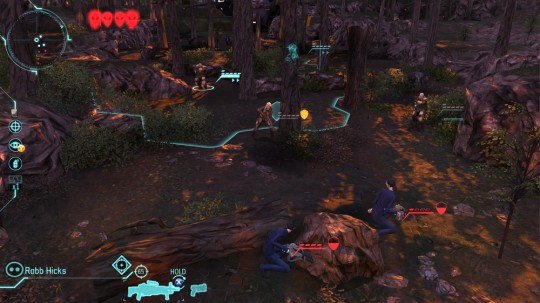
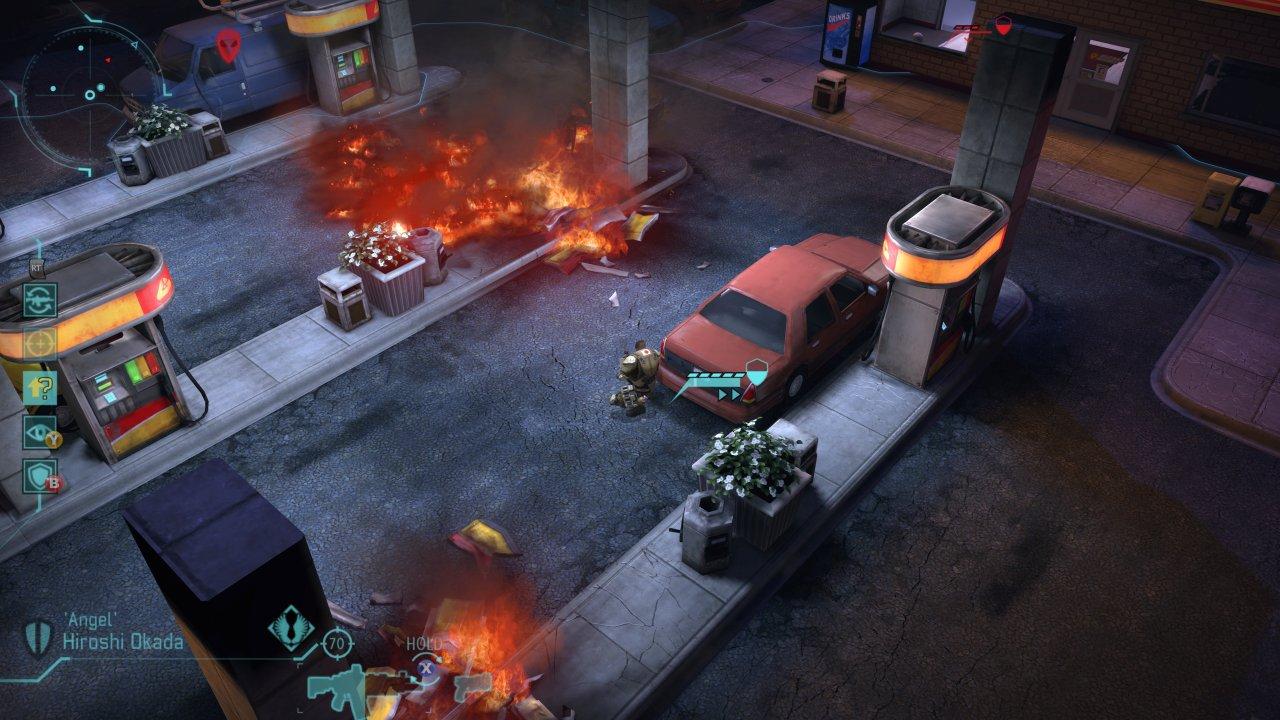
The big influence is totally that original game. Like, everyone on the team loved District 9 when that came out and stuff like that, but the original XCOM has influenced us from everything. That feeling of having a mission where it might be on your street corner or on your block with different houses – everything looks very familiar to you, but then there’s something a little bit off when you see those eyes in the fog of war. And we wanted to create that feeling in the combat missions where you see a gas station that may be very recognizable to you, or you see a fast food restaurant, but there is something wrong going. There are cocooned bodies that you are coming across.
Storytelling in video games can be more ambient like that, and we really wanted to focus on the ambience of the XCOM story. XCOM has never really been about linear narrative, the traditional narrative arc. We wanted to capture the atmosphere and the player agency. Those were the biggest things.
Where did you draw the line between honoring the original game and getting trapped by it?
The original game is very near and dear to us. Originally we did say here’s all of the tenants of the original game we love, it was this big laundry list of items, and we said we want to recreate these, we want to reimagine it in our own way. Actually one of Jake’s early prototypes was essentially a remake of the original XCOM with better graphics. And it was funny, because we play tested it, and original hardcore fans of XCOM loved it. They were like “oh great, this is what we know and love from 1994.” But then we play tested it, and game design has evolved from ’94, and some things were a little too abstract for players that weren’t familiar with the original XCOM. The learning curve was a little bit too steep.
We said “we love this franchise so much we want as many people as possible to enjoy the magic we experienced.” That doesn’t mean watering it down or dumbing it down, it means taking those core pillars like permadeath, fog of war, classic aliens, turn-based strategy, the strategy layer where you can build your own base – and then taking those pillars, but then maybe we can massage the mechanics underneath them to be more appropriate for 2012. That’s what it was about. But as long as we were upholding those pillars we were happy.
Game development is a totally different world than it was in 1994. Do you build a game with the current tools in mind, or do you have the idea and fit it with the tools available?
 Yeah, that was clearly part of it. Jake had this idea for a long time to remake it, going back to 2002, 2003. And one of the major concerns was the technology, and the 3D was not there yet to support fully destructible environments, a 3D fog of war, these certain things that we wanted to do. But when we explored Unreal Engine, we prototyped some things and said we do think we can do justice – technically — to what the original 2D XCOM did in 1994. We do have the tools now.
But you’re absolutely right, some of those pillars were hinging directly on tools, and do we have the technical knowledge and the tools to pull that off. That’s why I think it – partially — happened a little bit later.
So was there anything that you wanted to add, but maybe the technology isn’t there yet?
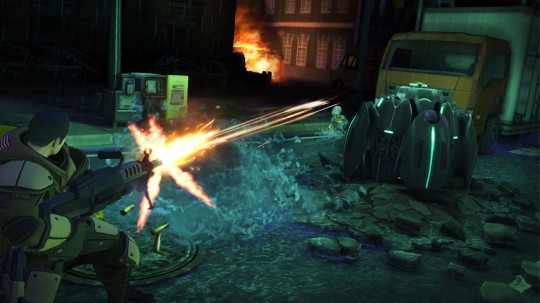
One of the new things we really wanted to get in there that took a lot of time to massage was the cameras that sweep down into the battlefield and make you feel like you’re directing an action movie and bring the player closer to the experience. We were very big fans of that, and we said “this is something different that clearly the original XCOM put in too, but it might be something neat. Why not put it into a sort of a modern version of XCOM where it’s a 3D world where there’s this beautiful art to look at, and you can make the player feel more empowered, like they are in the middle of this tense battle?” So that was a technical challenge and it was a creative challenge. We have a cinematic lead that really helped with that. We took a lot of time to get that right, but we’re happy with how that turned out.