Prototype E Ink Android phone puts your AMOLED screen to shame (but only in direct sunlight)

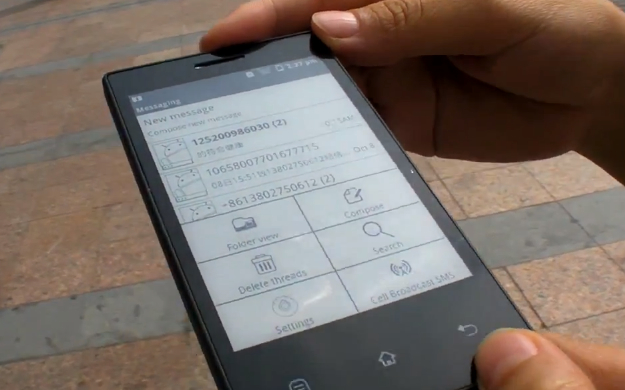
Onyx E Ink Smartphone

Onyx International, a company known for its range of e-readers, has shown off a prototype Android smartphone with an E Ink display. While the outdoor legibility and battery life are both excellent, the screen does let it down in other areas.

As every owner knows only too well, smartphone screens are difficult to view in direct sunlight, and while pushing the brightness up to maximum can help, it doesn’t do wonders for the battery life.

Here’s an interesting solution to the problem from a company named Onyx International, a smartphone with an E Ink screen. Onyx has plenty of experience in the world of E Ink screens, as it produces the Boox series of e-readers. The handset is only a prototype at the moment, but you can see a working version in the video below, where its screen is compared to a Galaxy Nexus.

The result is spectacular, as the Nexus device just looks like it’s turned off the entire time, while the Onyx phone’s display is crisp and sharp, despite being viewed outdoors. This probably won’t come as a surprise to anyone who has used an e-reader over the past few years, and the superior performance of an E Ink screen in sunlight formed the basis of a recent Amazon Kindle ad campaign.

Surprisingly, the Onyx phone runs Google Android, which has been extensively modified to run on a monochrome screen, but as you can see, the core functionality is still there. Because E Ink screens only take little sips of battery power, the standby time on the prototype is a week. Try that on any other smartphone.

There are, however, one or two little drawbacks. E Ink displays aren’t known for their speed, and sure enough the refresh rate is terribly slow, meaning any multimedia or gaming would be impossible. Viewing text webpages is good though.

While it’s an impressive technical feat and the use of an E Ink screen on a phone certainly has its benefits, the thought of enduring those long refresh times and not being able to do the things that almost all other smartphones can do, would probably make ownership too frustrating. After all, If I wanted a long standby time, a monochrome screen and little else, I’d buy a basic feature phone.

Take a look at the video showing the phone in action and see what you think.


Source : digitaltrends[dot]com

iPlayer for Android gets Jelly Bean support

iPlayer for Android gets Jelly Bean support

iPlayer for Android - flashy

As promised, a new version of iPlayer for Android has hit Google Play making the mobile catch-up TV service compatible with Jelly Bean, now known as BBC Media Player.

The app has had a behind-the-scenes overhaul to make sure it can work with both older, Flash-based Android iterations and the brave new Flash-less world that is Android 4.1.

To do this, the BBC has created the BBC Media Player app, which allows handsets to play the Flash-based video content on BBC websites through a spot of clever redirection.

Misdirection

Not all the videos across the BBC websites and iPlayer are compatible with the app just yet, although the BBC has started rolling out updates so the error messages should lessen over time.

The BBC's way of getting around Android ditching Flash is to use the Adobe Air-based Media Player app.

Unfortunately there's still no sign of iPlayer downloads coming to the Android app yet, something that iOS users have smugly been enjoying for some time now.

Android users can download the app from Google Play now.


Source : techradar[dot]com

Google and Samsung shun Intel, announce Exynos-powered Chromebook

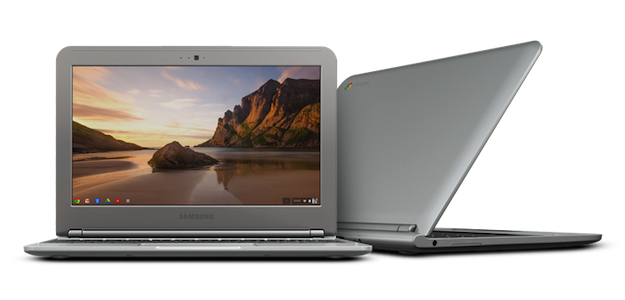
Samsung Chromebook

Samsung has once again partnered with Samsung to produce a laptop running Chrome OS. The new model shuns Intel's chips, and has a very attractive price tag too.

Google has once again collaborated with Samsung to release a laptop with Chrome OS installed. The new model is simply called Chromebook, and is smaller and lighter than the Chromebook 550. It also marks a departure from Intel’s chips, as it’s based on ARM architecture instead.

The new Chromebook has an 11.6-inch screen, smaller than previous models, but with a higher (and more traditional) 1368 x 768 pixel resolution. The Atom processor has been removed and Samsung has installed its own dual-core Exynos 5 Dual chip.

This is exciting for several reasons. Samsung’s Exynos 5 Dual was the first chip to use ARM’s Cortex A15 architecture — the same as Qualcomm’s quad-core Snapdragon S4 Pro — and the Chromebook marks its first appearance after being announced in August. It’s also expected to appear in Samsung ’s next generation tablets and although no clock speed is mentioned for the Chromebook, the chip can run at up to 1.7GHz.

Samsung and Google’s move to ARM is also good news for our wallets, and the Chromebook has been priced at a very competitive $249 in the US and £229 (if purchased online) in the UK.

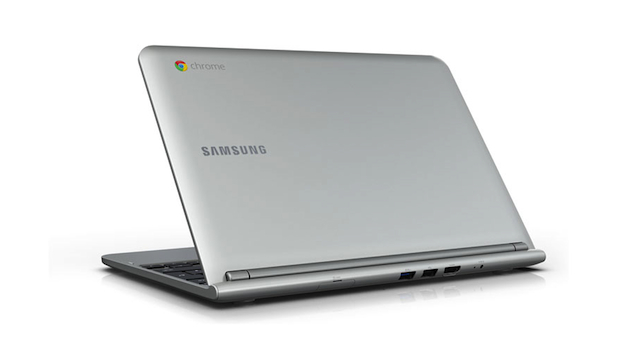
Samsung Chromebook Rear

For this you get a 16GB SSD that provides a 7-second boot up time, 2GB of RAM, a memory card reader, a pair of USB ports, an HDMI-out, Wi-Fi, a VGA camera, Bluetooth 3.0 and a battery that promises more than 6 hours of use before needing a recharge. The chassis weighs 2.5lbs, or 1.1kg, and measures 20mm thick.

As the whole point of the Chrome OS is to work in the cloud, Google will make up for the pathetic 16GB of onboard storage space by providing a complimentary 100GB chunk of Google Drive space. The small print points out that this is only valid for 2 years, after which time it’ll revert back to standard and you’ll have to pay.

So, the price is good and the spec is interesting, and to help introduce buyers to Chrome OS, Google will promote the new laptop in stores through special “Chrome Zones.” However, with the impending introduction of Windows 8 and all its associated hardware, will the Chromebook get a look in, regardless of its low price?

The new Chromebook is available as a pre-order from Best Buy, Amazon, TigerDirect.com and Newegg.com, or from PC World in the UK right now. According to the latter, it’ll be released on October 19.


Source : digitaltrends[dot]com

Huawei Ascend Mate could be 6.1-inch giant

Huawei Ascend Mate could be 6.1-inch giant

Do you want to be friends?

A mammoth 6.1-inch smartphone could be in the works over in China, as details of the Huawei Ascend Mate get their first airing.

According to a report from MyDrivers, the super sized device was apparently spotted on Huawei's Chinese website, sporting a huge 6.1-inch, 1080p display which would put the 5.5-inch Samsung Galaxy Note 2 to shame.

As well as the screen size, other details of the monster phone were also leaked, including a 1.8GHz quad-core processor, 2GB of RAM and 4,000mAh battery.

World's most powerful smartphone

If these specs are to be believed then the Ascend Mate is set up to be the world's most powerful smartphone, an accolade currently held by its closest rival, the Galaxy Note 2.

The Ascend Mate will apparently measure a relatively slender 9.9mm in depth, and while there's no official word from Huawei about the device, it wouldn't be a surprise to see other manufacturers take on Samsung's mega-super-phone.

There are no details surrounding a potential Huawei Ascend Mate release date or price, so we've contacted the Chinese firm to see if it can shed any light on the news.


Source : techradar[dot]com

O2 rolling out Android 4.1 to Samsung Galaxy S3 today

O2 rolling out Android 4.1 to Samsung Galaxy S3 today

Buttery smooth experience with Android 4.1

O2 has confirmed that it will start rolling out the Android 4.1 update to its Samsung Galaxy S3 customers today.

Three was the first network in the UK to push the Jelly Bean update out to Galaxy S3 owners yesterday, and it has now been joined by O2.

The news was revealed yesterday on O2's community forum, with Abs from the O2 Social Media Team saying:

"From tomorrow, 19th October '12, you'll be able to upgrade to the much awaited 4.1 Jelly Bean update over Wi-Fi or via Kies."

Auto-update alert

In our Samsung Galaxy S3 review the handset received high praise and sits proudly at the top of our 20 best mobile phones in the world today – which goes some way to explaining why it's been so popular.

We're yet to hear from Orange, T-Mobile or Vodafone on Jelly Bean, but all three are expected to push the update to customers in the coming weeks.

Update: A T-Mobile spokesperson has told TechRadar: "T-Mobile is working closely with its device manufacturing partner Samsung to roll-out a Jelly Bean update for as soon as possible. As soon as we have an exact timeline in place we will confirm."

Update: Samsung has told us: "Samsung UK can confirm that the roll out of Android 4.1 (Jelly Bean) has begun for our Galaxy S III customers and will be available across all networks over the coming weeks, pending software testing and approvals."


Source : techradar[dot]com

It's free
index