Four years after Criterion finished Burnout Paradise, the studio returns to the open world format. While the sterile seriousness of the Need For Speed series has seeped into its formula, Criterion has made another spectacular game.
 Need For Speed Most Wanted starts with all the humor and self-awareness of a Levi’s ad in the back of Maxim. It’s got that same wet-eyed sense of self-importance and put-on sexiness as those horrible “Go Forth” spots. A Muse song simmers in the background as dramatic, hazy shots of the city of Fairhaven and its automobile citizens parade by and a breathy female voice welcomes you to the game. It’s not the invitation back into Criterion’s open world driving that people have been waiting for these four years since Burnout Paradise. If that game was full of youthful guileless and boundless enthusiasm, Need For Speed: Most Wanted comes off like a petulant teen that’s too cool for school. Bright-eyed fun? That’s for babies.
The comparison to Paradise is unavoidable. The sprawling highways and city streets, the industrial parks and massive jumps, all those delightfully crushable billboards and security gates to the side of the road: This is Burnout Paradise 2 in everything but name. As first impressions go, though, the one made by Most Wanted is misleading. It does indeed take itself too seriously, but it is a beautiful and deeply fun machine all the same — the opposite side of Paradise’s coin.
Take It Easy
Before talking about the game’s vehicles, it’s important to talk about Most Wanted’s most distinguishing feature: EasyDrive. Criterion has sloughed off the baby fat that made Burnout Paradise’s beautiful bay and surrounding hills difficult to navigate. No more getting lost on your way back to the start of an event you want to retry and no more hunting for the car you need for a specific race right when you need it.
 Mapped to the directional pad on your controller, EasyDrive is a pull up menu that addresses your every need. Pressing right brings up a menu for selecting which car you want, car customization options, your current car’s events (each car has five individual races), access to multiplayer, and the Most Wanted list (more on that in a moment.) Picking which race you want highlights the fastest route to the start on the map below, but after you’re tried it once, you can start the event automatically from Easydrive. It’s hard to overstate how smooth this system makes the game, efficient without sacrificing the do-what-you-will feel of the open world.
Even the game’s odd geographic rules for the cars don’t muddle it too much. Picking a new car sends you off to where you discovered its Jack Point on the map, potentially on the other side of the world from your current location (Most Wanted’s crime theme is pretty loose, having you boost cars in the wild, but since there are no pedestrians in Fairhaven it feels a little silly). I only found that I needed to change cars so I’d have a better machine for a Most Wanted race I’d already lost, so it’s not a huge annoyance.
Incredible Machine
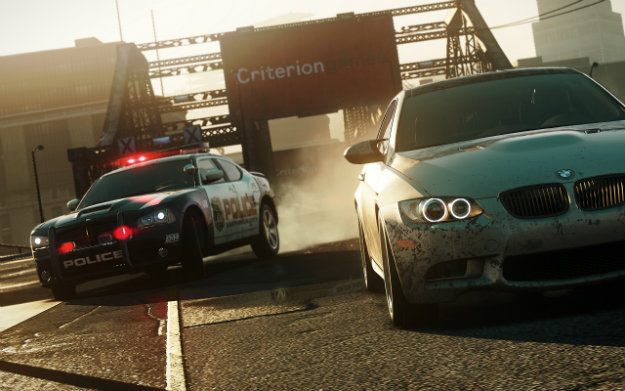
There are ten Most Wanted races in the game, and those are the heart of the campaign. Most cars are discovered tucked away in Fairhaven’s dark corners, and most of your time is spent searching for them then playing their five events. These break down into circuit races on a looped course, sprints on a single path, sprints where you have to keep a high average speed, and escape the cops events. Provided you win, you’re awarded with upgrades (nitrous boosts, lighter chassis, off road wheels, etc.) and Speed Points. Once you have enough Speed Points on your profile, you get to take on the top ten Most Wanted cars; rich man’s machines from Lexus, Mercedes, Lamborghini, and others. You race these machines in a car of your choice — it really needs to be fully upgraded for you to prevail — while avoiding increasingly aggressive cop cars and blockades. Beat it, then take it down to add the car to your roster.
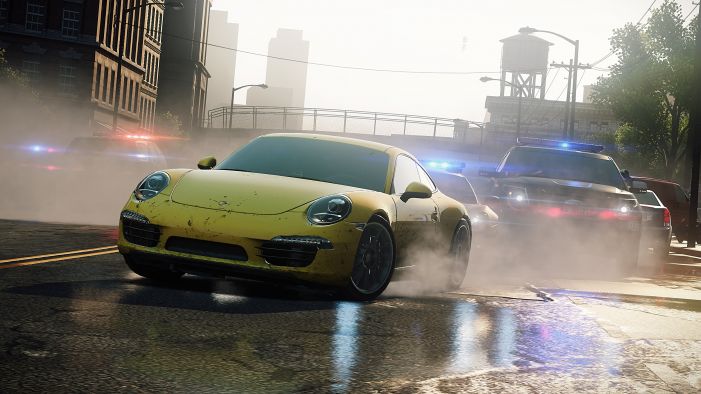
It’s marvelously addictive and more varied than it seems at first look. Sampling exotic cars like a Porsche 911 and an Audi R8 Spyder before taking on the Most Wanted makes it feel like all the races for each car are the same, but hop into stocky beasts like the Lancia Delta HF Integrale and you’ll find the sprint races transformed into jump-filled rallies across construction sites and train tracks. There’s always something new to do, even if it’s just cruising around, hunting for new cars.
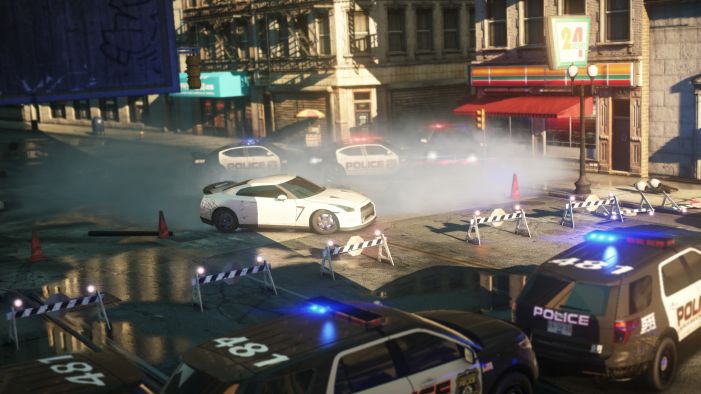
 Speaking of those cars, they are indeed beautiful, a bountiful collection of real world vehicles that range from the most mundane Ford pickup to the most wild Italian concept. Fairhaven is also beguiling. The spray of mist kicked up on wet roads and the flush of lights on its streets, perpetually shadowed even in daylight, make this the most visually impressive Need For Speed I’ve played. There’s a pervasive sterility in the game, though. All of the cars and city blocks feel too perfect. When you zip around a park, knocking down street lamps and trashcans in a reign of destruction only to find everything perfectly replaced on the next lap, it’s disconcerting. Fairhaven doesn’t feels less like an actual place, as Paradise City did, and more like grownups’ Matchbox playset.
Sexy sterility is Need For Speed Most Wanted’s bag in every regard really. When you’re introduced to a race and one of the Most Wanted cars, it’s through an arty short with weird camera angles and effects like a car being sucked out of what looks like white paint, glimmering as it emerges like a Playboy centerfold for engineers. When you got a new car in Burnout Paradise, it plopped down in your garage like a dirty heap of parts.
Autolog, Multiplayer, and Vita
But wait! There’s more to Most Wanted than the console and PC game’s core! Special mention needs to be made of the PS Vita version of the game. Criterion itself made the portable version of Most Wanted, but “portable version” is something of a misnomer in this case. Most Wanted Vita is the exact same game — same city, same cars, same races — as the one on Xbox 360, PC, and PlayStation 3, plus a smattering of exclusive races to boot. Everything said above holds true, but the Vita version of the game does lay bear how great the racing truly is.
The primary difference between it and the console versions is the look of Fairhaven. The cars are almost just as glossy, but the environment has been stripped of the textures, lighting, and particle effects (sparks, etc.) that make the console versions such spectacles. It doesn’t look bad. Far from it. The Vita city simply looks much simpler. The game doesn’t suffer for it. All the things that make Most Wanted good are preserved and it’s one more precious essential for Sony’s handheld.
 For those of you thinking about getting the Vita version and the PS3 version for seamless home and portable gaming, bad news: Cross play isn’t supported. There is, however, cross play-like functionality between the Vita version and all console versions thanks to EA Origin and the game’s Autolog. Since your Autolog and its attendant Speed Points are tied to your EA Origin account, that same account carries over to your PS Vita game. You won’t have all the cars you’ve unlocked on PS3 or Xbox 360 accessible on your Vita (and vice versa), but you will have the requisite points to automatically compete in Most Wanted races.
You will also have complete access to your ranking and roster of cars in multiplayer. Multiplayer in Most Wanted includes a variety of unique events as well as the race types seen in the campaign. Competing and winning earns points, which raises your level, which in turn unlocks new cars to use when playing with friends. This being Autolog-specific info, multiplayer is ready to go on both platforms provided you use the same accounts.
Conclusion
Need For Speed Most Wanted is Burnout Paradise’s equal. The driving is pristine and primal, the drifts succulent and the crashes shocking, just as it always is in Criterion’s drivers. The crisp efficiency of EasyDrive makes Most Wanted a more direct game than its predecessor, a boon for achievement-oriented players, but there’s no sense of messy freedom and goofiness here. A winking DJ Atomika doesn’t compliment the greasy pop soundtrack. You can’t press in the analog sticks to suddenly cause a massive pile up on the highway, crashing for points. It’s a matter of taste. Do you prefer the fantasy of the beach or the cool logic of the city grid? If you lean toward the latter, Most Wanted is your game.
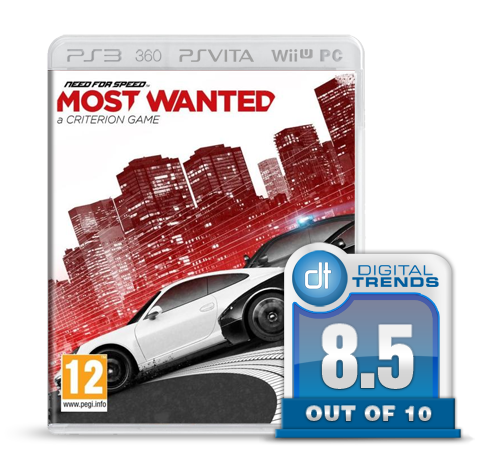
Score: 8.5 out of 10
(This game was reviewed using PlayStation 3 and PS Vita copies provided by Electronic Arts)