Word that Microsoft is working on an own-brand Windows Phone handset keeps resurfacing, with the latest reports saying that it's currently in testing.
The Wall Street Journal says that Microsoft is testing the mysterious Microsoft smartphone with Asian suppliers, presumably with a view to working out manufacturing processes.
The same sources also told the paper that the Microsoft phone will come with a display somewhere between 4- and 5-inches.
Time will tell
However, they also added that Microsoft isn't yet sure if the handset will make it to mass production.
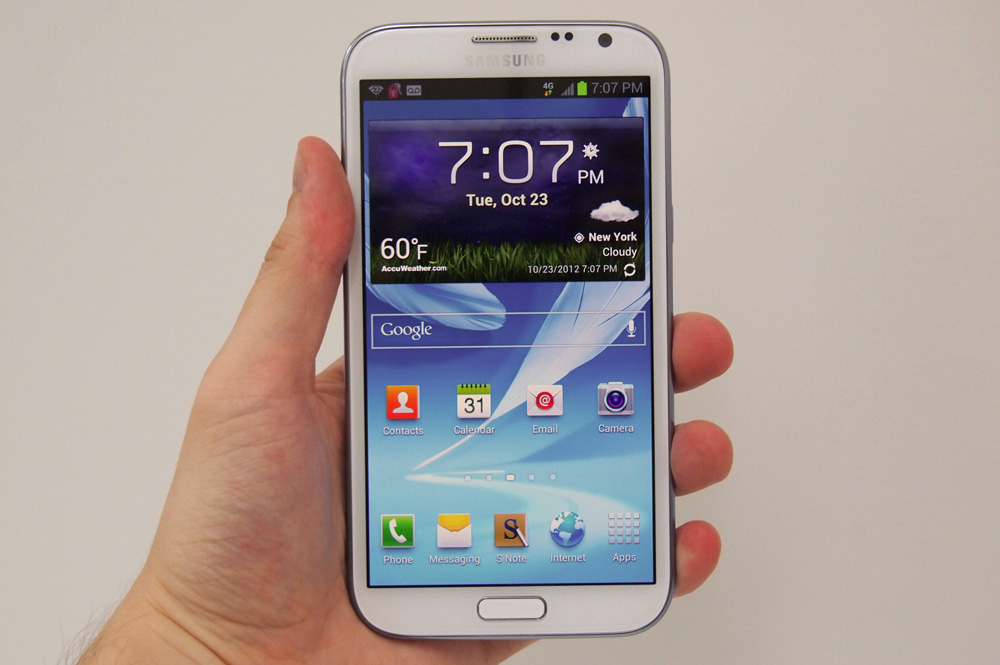
Samsung has announced that it has sold 3 million Galaxy Note 2 tablet/smartphone hybrid devices, despite it only have been on sale since September. That's a lot of sales for a niche product, so where is its competition?
Samsung must be looking at the latest sales figures for the Galaxy Note 2, which it has just made public, shaking its head and then having a good laugh. It has released a device nobody thought they wanted and critics instantly took against, then went on to sell millions of them. So why is it laughing? Because there still isn’t any competition.
The Galaxy Note 2 went on sale during September in Korea, reached the UK on October 1, and has steadily made its way to the US and other regions around the world since. According to Samsung, in 37 days it has racked up more than 3 million sales.
The original Galaxy Note arrived in September 2011, but didn’t reach 1 million sales until the end of December, so the Note 2‘s performance is impressive going, particularly when you take into account the Note 2 is still a niche device.
But is it so niche that it doesn’t need some competition? Who does Samsung think it is? Apple? Has it really produced an initially derided product that in reality, just caught other manufacturers napping?
Rumors and half-releases
It seems so, as viable alternatives to the Note 2 are few and far between, despite the product line having been on sale for more than a year. There’s the LG Optimus Vu, or the LG Intuition if you buy it from Verizon; but in its infinite wisdom, LG hasn’t bothered to give it a wide release, so its sales are unlikely to impress.
HTC’s bizarrely named J Butterfly phone has a 5-inch, 1080p screen, but it’s only available in Japan, while Panasonic has picked up its 5-inch Eluga Power and taken it home, after it failed to gain any traction in the European market. At least these have seen a release, as phones such as the LG Optimus Vu II, the Oppo Find 5, Lenovo’s S880 and the Thomson X-View 2 are all seemingly in some kind of release date limbo.
Huawei and ZTE have woken up and started talking about their own tablet/smartphone hybrid machines. For Huawei, it will be the Ascend D2 and the rumor is it will be equipped with a quad-core chip and a 720p 5-inch display. ZTE’s Nubia Z5 will have the same specification, but will add a 13-megapixel camera too. Neither are confirmed though, and both are likely to do the rounds in China before possibly going international sometime next year.
There are also a few other rumored devices with 5-inch-plus sized screens coming soon. HTC may adapt the J Butterfly for international release — possibly to be named the Droid DNA and launched on the Verizon network — while the Sony C650X, codename Odin, may arrive next year too, along with a 6-inch screen version codename Yuga. Both of these and the Droid DNA are said to have 5-inch, 1080p screens.
All this gives the Galaxy Note 2 an almost entirely open playing field until well into 2013. How many Note 2 handsets will it have gone on to sell before a true alternative finally goes on sale?
A splash of colour, Microsoft's latest mobile platform and a sleek new body are combined with more powerful hardware - is the 8X the phone to bring Windows Phone 8 to the masses?
HTC's been in a bit of a weird position these last few years. From the days of anonymity when it made Windows phones for others, it rode the crest of the Android wave when Google's platform launched becoming, pretty much, the Android handset OEM of choice.
And then Samsung happened. HTC's offerings appeared to dip and even the pretty fantastic One X – struggled to make inroads against the seemingly unstoppable Galaxy line, currently led by the superb Galaxy S3.
HTC was up there at the starting block when Microsoft launched Windows Phone a couple of years back, and although it's competing with Samsung in this arena too – and its offerings haven't been what one would call "amazing" – HTC is clearly trying to make its voice heard.
And what better way to do that with some pretty bright colours and a newer version of Windows Phone that the world's been waiting for for months?
The HTC 8X comes in a range of colours - from muted black, to respectable red, to an elegant purple and a, quite frankly, hideous lollipop-lady yellow hue.
We were sent the purple model and it's a beauty. There had been rumours that the red would be reserved for Verizon users in the US – but it looks like the rest of world is now getting it too.
First thing we noticed is how thin the HTC 8X is. Not so much an amazing feat of engineering, but a clever trick.
With dimensions of 132.4 x 66.2 x 10.1mm, the HTC 8X is fairly average in size. But it's thinner round the edges to give the impression it's more svelte than it actually is. Not that this matters because it looks and feels thin most of the time and the slight curve around the back means it sits well, both on a surface and in the hand.
In fact, in the hand, it looks the same size as the HTC One X, despite the appearance given in our picture above.
Add to that the material the HTC 8X is made of – polycarbonate, like the One X – and you instantly have in your mitts a handset that feels like a real premium device. It's a unibody design so it's all nice and neat (win) but at the expense of a memory slot and replaceable battery (fail).
The front of the HTC 8X is taken up by the display. If you like what Nokia did with the Lumia 800, or indeed what HTC did with the One X, you'll be a fan of this too.
The screen just looks like it's been stuck on top of the phone and adds to that premium feel. There's also a splash of colour around the earpiece to remind you that the two are linked.
Next to this, you'll find the front-facing wide-angled camera, and the three Windows Phone softkeys at the bottom – back, search and menu.
That screen is an HD display at 720x1280. Spread over 4.3 inches, it's easily as sharp as Apple's retina display, which no longer appears to be anything special by modern standards.
The top of the HTC 8X is fairly minimalist with nothing other than the 3.5mm headphone jack and the lock button. Although we're not necessarily fans of lock buttons on top of larger phones due to the awkwardness they present, here, we weren't too fussed.
Due to the shape of the handset and the way it sits, it's easy enough to press with the index finger whether you're a left or right hander. Our only complaint is it is quite subtle and a few times, we had to feel around to find it if we were looking elsewhere. It doesn't stick out much.
The left hand side of the HTC 8X is completely bare, whilst all you'll find down at the bottom is the micro USB charging and syncing port.
The volume rocker is on the right and below it is a camera shutter key. We are always pleased to see these because it makes the art of launching the camera and taking a photo so much easier than messing about with software, no matter how good said software is.
There's also a tray for getting that micro SIM in – but you'll need to use a special tool to open it so make sure you keep it in a safe place.
The rear of the HTC 8X is a thing of beauty. That polycarbonate body really sets it off – as does the colour which sits beneath a silver HTC logo and another displaying the Beats Audio heritage. And of course, there's that main snapper with LED light which HTC promises will deliver amazing results.
The 8X will be pitching itself right against Nokia's latest Lumia range – and with the Lumia 920 also coming in a number of colourful iterations, telling them apart may be harder for those who aren't as used to Windows Phone products.
But there is a difference in that the HTC 8X doesn't come with 4G LTE connectivity in the UK, whilst the Lumia 920 does. Which means it'll likely be cheaper – and that may be its saving grace for late adopters.
Expect the HTC 8X to launch at the start of November. With this in mind, there are no real deals to be had yet, but preorder prices are sitting a shade under the £400 mark (USD: $640 / AU: £620) for a 16GB sim-free unit.
This will be HTC's flagship Windows Phone handset, so don't expect it to be in the bargain bucket. Prepare to pay at least £30 a month for two years.
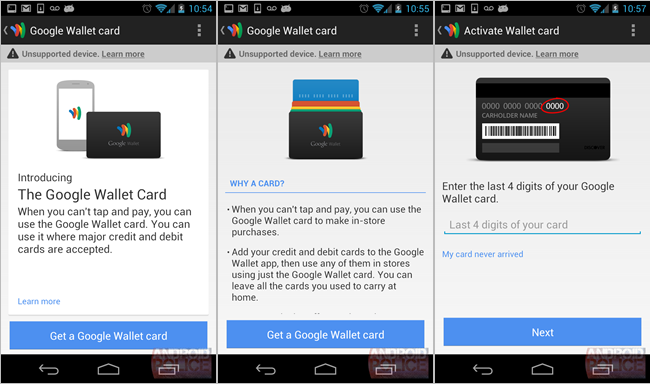
Leaked screenshots of an update to Google's Wallet App that hasn't been pushed yet shows evidence that a physical Google Wallet Card will be made available for instances where you can't make purchases with your NFC-enabled Android phone.
Digital wallet services are flooding the market, despite the many barriers between them and consumers pockets. Apparently, Google is trying to alleviate some of this existing friction with a tangible solution. Android Police received an anonymous tip and series of screenshots showing off a Google Wallet app promoting a physical Google Wallet card. According to the screenshots, the Google Wallet Card will be a physical credit card used in lieu of the multiple credit cards you have in your physical wallet.
The screenshots might have been taken by someone who had early access to an updated Google Wallet app, and it shows off a leaked informational page explaining the advantages of a Google Wallet Card. The cards are likely intended for brick-and-mortar shops that haven’t adopted NFC reading terminals or even iPad-based solutions.
The card is supposed to bridge the gap between the new and old payment systems we’re stuck in. On one hand it’s a credit card like any other, but it digitally stores all of your existing cards so you can leave the multiple pieces of plastic at home. Users will defer to the Google Wallet app to indicate which credit card stored on the physical Google Wallet Card they want to swipe.
There are a few advantages to this system. For instance, if you lose your wallet, you’re not forced to cancel all your cards. In fact, “you only need to cancel your Google Wallet Card (not every card in your wallet).” You’ll also probably be able to request a new Google Card with the press of a button in the Google Wallet app. Some bonus security measures appear to include 24/7 fraud monitoring, and the ability to remotely disable your card at any time.
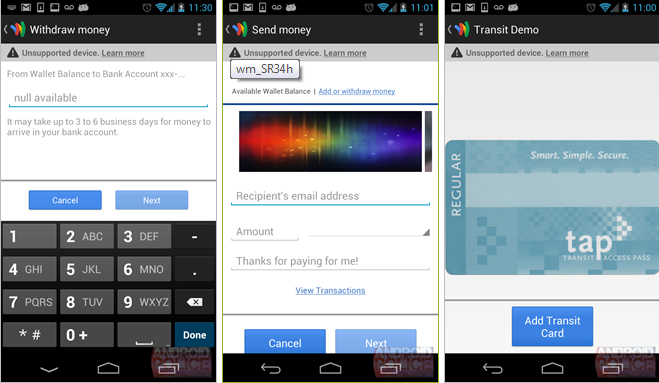
The second part of the leak introduces withdrawing money or sending money to a “Wallet Balance,” which seems to be a debt-like account where you can store, send, or spend money. It may suggest being able to soon use the Google Wallet Card as a debit card itself, independent of the stored credit cards. Finally, the screen shot shows evidence of the ability to add a transit card, like a New York City Metro Card for instance.
Of course until Google gets back to us we’re merely speculating, but the screenshots are incredibly telling: Google is aggressively entering this market and competing with the likes of Square and even more so Apple Passbook.
Walt Disney Animation Studio return with Wreck-It Ralph, a film steeped in the world of video games. But at its core, the digital overlay is simply the setting for a traditional, and heartwarming story of a guy who makes a friend.
Although the days of the arcade are on the wane to the point of extinction, there will always be a certain subset of people who have grown up with the influence of those institutions ingrained upon them. During the 80s and 90s, the arcade was a place where you could go to experience something new. It was a place to hide away for a few hours, or a place to socialize in a new way. For many it was an escape, while for others it was a babysitter, reassuring parents in the knowledge that they could leave their kids there and those kids would be content to hover around the games like moths around a light without even entertaining the thought of wandering off.
Over the years though, the evolution of technology has not been kind to these digital meccas. Prices went up, while the convenience and sophistication of the product moved to the home. A handful of arcades remain, but they are few and far between. They will always exist, however, in the hearts and minds of those that experienced arcades in their prime. It is to those people that Wreck-It Ralph has been promoted through trailers and promotional materials. But while the film is certainly heavily influenced by those unique days, the story is a deeper and more universal tale.
That arcade influence is at the heart of Wreck-It Ralph, but it is not the driving force. Beyond the flashy cameos of characters like Pac-Man and Street Fighter’s Zangief, there is a story of a lonely guy, badly treated and shunned through no fault of his own, who befriends another lonely and isolated character that just wants to be accepted. Like most of Disney’s animated films it is a morality tale, and one that is created to appeal to all ages. In that, it succeeds.
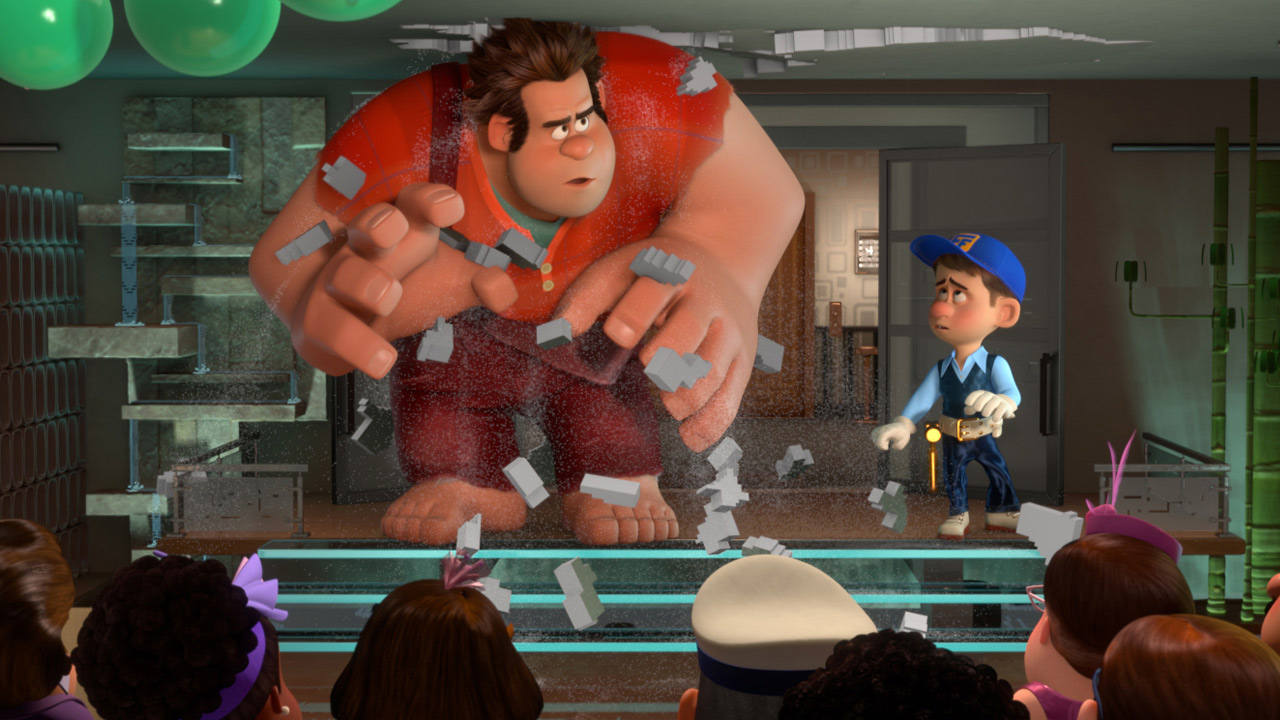
After 30 years as the unappreciated antagonist of a Donkey Kong-like arcade game called “Fix-It Felix Jr.”, Ralph (voiced by John C. Reilly) has begun to question his role. After being shunned by his fellow characters at the anniversary party for their game, Ralph decides that the only way he will ever belong is to prove that he can be a hero too. Things soon go wrong, and Ralph accidentally leaves a trail of mishaps in his wake, forcing his own game’s hero, Felix (voiced by Jack McBrayer), to come looking for him.
Through a bizarre turn, Ralph finds himself in a game called “Sugar Rush,” a candy-themed kart racer (created for this film, but bearing more than a passing similarity to Mario Kart), where he meets the annoying, but endearing Vanellope (voiced by Sarah Silverman). But Ralph’s journey has caused bigger problems than he knows. With Felix on his trail thanks to the no-nonsense Sergeant Calhoun (voiced by Jane Lynch), Ralph’s actions could spell doom for the entire arcade.
The hook of Wreck-It Ralph is, of course, the gaming-inspired world that Ralph and his cohorts inhabit, but that is actually a fairly small portion of the overall package, just as the toys were just the setup to tell a much deeper narrative in Toy Story. If anything, the promotion of this movie has been a little misleading. Although publicized as a gaming-centric film, the gaming icons are there for only a very small potion of the actual movie. Of the eight characters from real games in the poster above, their combined screen time may be five minutes, and three of those come in one scene at the beginning. That isn’t really a criticism though, just a note that the promotion of this film has been focusing so heavily on its ties to the gaming world that you may not expect to find that it is actually a minor aspect of it in the same way that toys are a relatively small focus of Toy Story. In both cases the world creates the rules, and in both cases the setup offers some original humor thanks to the subject matter, but the heart of the story runs deeper than that.
Director Rich Moore (Multiple Simpsons and Futurama episodes) certainly understands the nostalgic appeal of the arcade, but that world quickly takes a backseat to the story. The arcade environment is simply the vehicle that offers the filmmakers a clever and entertaining backdrop to tell a deeper and more heartfelt story of friendship and acceptance. It comes across a touch heavy handed for the more cynically minded, but there are moments that are actually fairly touching even if they are a bit predictable.
Wreck-It Ralph doesn’t quite hit that level of originality or emotional resonance of the brilliant Toy Story series, but it is possibly the best animated film of the year. Brave and ParaNorman both have a horse in that race as well, but the humor, originality of the universe, and story that hits all the right emotional notes, make Wreck-It Ralph the leader.
The artwork is also beautiful and expressive, and the characters emote a great deal. The voice cast is involved in the story, not just reading dialogue. Even when the story does begin to stray into predictable territory – and it does so heavily, especially at the end with the twist you’ll see coming from a mile away – the art can help keep you engaged.
Conclusion
Although the “hidden world of gaming” promised by the advertising is actually more of a background than a feature, Wreck-It Ralph has more than enough on its own merits to make a worthy entry into the Walt Disney vaults. There is a simple, but universal story at play that will appeal to all ages, and it succeeds because of the sharp writing, endearing animation, and great voice work. It is a touch formulaic, but ultimately satisfying and worth the time. Your inner child that still yearns for the days of the arcade will thank you for it.