Facebook planning new messaging app with self destruct function

Facebook planning new messaging app with self destruct function

Facebook - big fan of privacy, as we all know

It's beginning to look a lot like Facebook will launch another mobile messaging app, one which destroys your communiqués after a certain amount of time.

The rumour fell out when All Things D gave its sources a festive shake; they say that the app will hit before the year is out, allowing users to set how long their messages and shared photos are accessible for.

Once that time period is exceeded, the photo, message or video will disappear from view and your correspondent will no longer be able to access it.

Secret squirrel

It's a lot like the functionality of Snapchat, an app which has become the sexting app of choice given its messages' impermanence; its makers are no doubt quaking at the thought of Facebook stomping into Snapchat's domain.

Facebook already has a selection of stand-alone mobile apps that are available separately from the traditional Facebook app.

These include a Messenger app that it recently updated on Android to allow people who don't have Facebook accounts to use it - the sources gave no indication of whether or not this more salubrious messaging app will be locked to Facebook account holders only.

If the insiders are right, the new Facebook app will hit app stores by the end of the year.


Source : techradar[dot]com

iPhone 5 breaks China sales record – two million sold in first weekend

Chinese iPhone

Consumers in China appear to have gone for the iPhone 5 in a big way, with two million units snapped up in its first weekend of sales.

There were no reports of riots or brawls, or even of eggs thrown in frustration. It may have been a picture of peace and tranquility outside China’s seven Apple stores this weekend, but the company still managed to sell two million iPhone 5 units during the handset’s launch weekend in the country.

“Customer response to iPhone 5 in China has been incredible, setting a new record with the best first weekend sales ever in China,” Apple boss Tim Cook said in a statement released Sunday night.

The Chinese market is Apple’s biggest after the US, and one that is of course continuing to grow rapidly.

Following crowd trouble outside a Beijing store on day one of iPhone 4S sales back in January, as well as chaos during the launch of the iPad 2 and white iPhone 4, the Cupertino company was keen to ensure there would be no repeat performance.

To prevent crowds gathering outside stores over the weekend, Apple used a reservation system for those wishing to get their hands on the latest iteration of its popular smartphone. Consumers were required to reserve a device online last week. They were then appointed a time to collect their device at the store. The system appears to have worked a treat.

Selling so many units in the space of just three days suggests any concerns over supply of the phone are now history. Terry Gou, boss of Foxconn, the firm that assembles the device, admitted last month that his company was “falling short of meeting the huge demand.” Factory workers were reportedly finding the handset more difficult to put together compared to previous versions largely because of its lighter, thinner design which required more precision from workers during its assembly. Component shortages also caused problems.

While two million is undoubtedly an impressive figure for first-weekend sales, don’t forget that when the iPhone 5 launched in the US in September, a record five million units were bought in its first weekend. Analysts believe the tech giant could sell as many as 45 million iPhone 5 units worldwide in the current quarter.


Source : digitaltrends[dot]com

YotaPhone has LCD display on the front, E-Ink display on the back

yotaphone

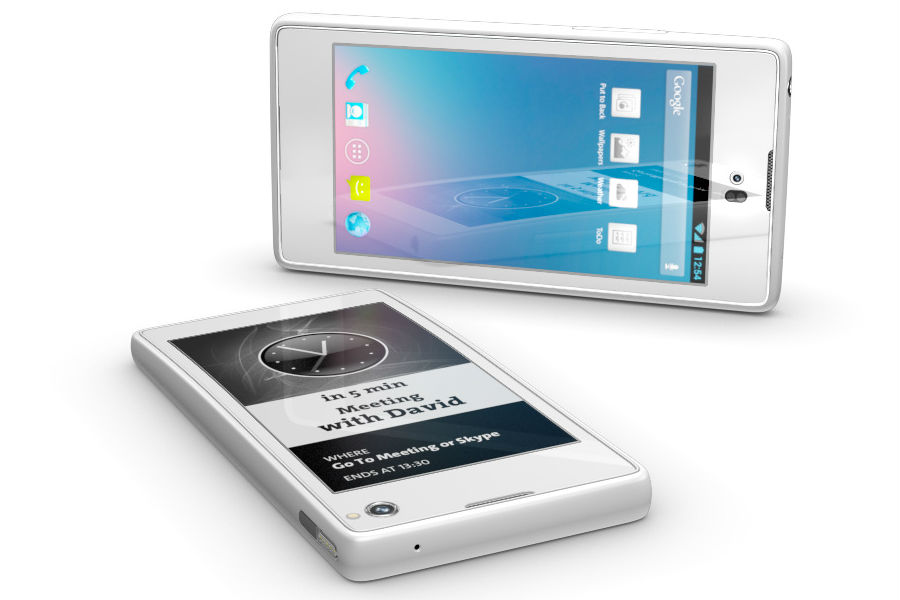
Combining the elements of a smartphone with an e-reader, the unique design of the Yotaphone may become very popular with consumers looking for both devices.

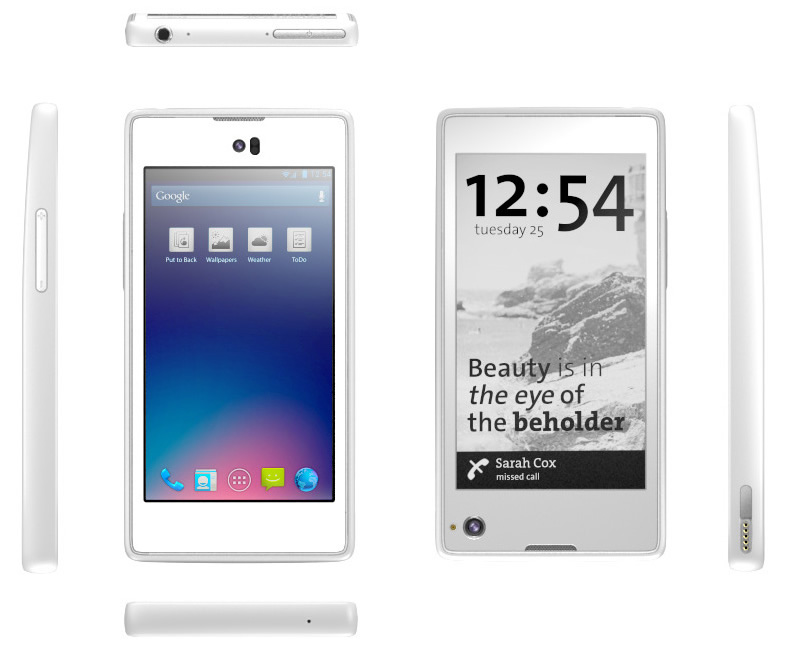
Announced on the official YotaPhone site, a Russian company called Yota Devices is currently developing a new design on the traditional smartphone by offering two types of displays for different tasks. Using Android 4.2 Jelly Bean as the software development platform, the 4.3-inch LCD on the front of the YotaPhone runs at 1280 by 720 resolution (720p) and is powered by a 1.5 Ghz, dual-core Qualcomm Snapdragon chip. On the rear of the device, Yota Devices has installed a 4.3-inch E-Ink display similar to the type of screen found on an Amazon Kindle or a Barnes & Noble Nook E-Reader.

yotaphone e-ink displayIn an interview with the Wall Street Journal, Yota Devices CEO Vladislav Martynov stated “We created this to be different. Most phones nowadays are boring, they are just boxes. This is a phone for people who want to be outside that box.”

Conceptually, the two screens are designed to work together to relay different information. For instance, the E-Ink display is perfect for delivering notifications about upcoming meetings or anything happening on social media networks like Facebook or Twitter. The display could also be set to constantly display basic information like the weather or the time. This could potentially help save on battery life since an E-Ink display requires less power to operate than a traditional LCD screen.

In addition, a YotaPhone user could use the E-Ink display to read news or books in direct sunlight rather than being forced to find a good angle on the LCD side of the smartphone. However, the user will have to rely on a touch strip to control the E-Ink display rather than touchscreen controls on the LCD. In addition, third-party developers will have to create applications to support the secondary E-Ink display. It may be difficult to encourage Android developers to include E-Ink display features unless the YotaPhone becomes extremely popular around the world. 

yotaphone dimensionsInterestingly, the LCD side also includes a touch strip that’s designed to replicate traditional buttons found on many Android smartphones. While the rest of the touchscreen reacts to finger taps, the strip offers basic Android navigation control like swiping between pages on the screen. 

According to Yota Devices, the smartphone will offer LTE connectivity as well as a 12-megapixel rear camera and a front-facing HD camera. Internally, the camera will operate on 2GB of RAM and consumers will have the option of 32GB or 64GB of flash storage for music, movies, games or other content. The smartphone is powered by a 2,100 mAh battery which is identical to the battery size in the Samsung Galaxy S III. Due to the two screens, the phone is slightly heavier at nearly five ounces compared to the 3.95-ounce iPhone 5 or the 4.7 ounce Samsung Galaxy S III. 

Yota Devices is targeting a product launch within Russia around the third quarter of 2013 and is currently in talks with wireless providers to bring the YotaPhone to North America as well as Europe. While Yota Devices won’t be showing off the YotaPhone at CES in Las Vegas next month, the company does plan to display the phone at the Mobile World Congress trade show in Barcelona during late February 2013.

yotaphone two displays


Source : digitaltrends[dot]com

Nokia Set to Release Windows Phone, Lumia 505

To all our friends in Mexico, are you wanting to get a Windows Phone, but not wanting to spend a ton of money?

Nokia is set to release its Lumia 505, which is essentially a scaled down version of the Lumia 510.  The handset is currently set to be released by Telcel in Mexico. The Lumia 505 has a 3.7 inch AMOLED 800 x 480 resolution display, an 8 MP rear facing camera, 256MB internal memory and 4 GB of available storage.

This phone runs Windows Phone 7.5 and will not be upgraded to Windows Phone 8 but is a good low cost alternative.  It is available in pink, red and black.


Source : mobilemag[dot]com

Terms & Conditions: Snapchat’s privacy policy has too many secrets

Snapchat is the Instagram of "sexting" thanks to its ability to make embarrassing photos disappear in seconds. Unfortunately for users, the controversial mobile app's privacy policy seems to remain shrouded in a bit of secrecy.

T&C SnapchatWhat are you really agreeing to when you click that fateful “agree” button? Terms & Conditions cuts out the legal lingo to spell it out in plain English.

The most controversial mobile app on the market right now is, without a doubt, Snapchat. And for good reason: The app allows you to “snap” photos (and now video) that are automatically deleted a set number of seconds after you send them to someone. As you can imagine, this self-destruct feature has instilled a false sense for users that it’s possible to send embarrassing (read: naked) pictures without having to worry about those photos making their way into the digital wilds of the Web.

Of course, that’s just not true, since it’s quite easy to take a screenshot of these fleeting photos with pretty much any smartphone. A classy blog called “Snapchat Sluts” quickly popped up (then disappeared), featuring – you guessed it – naked photos of women taken with Snapchat.

Given the contentious and inherently naughty nature of Snapchat, a look at what the apps terms of service and privacy policy are in order.

Note: Snapchat does not make it possible to link directly to either its terms or privacy policy; you just have to go to the website, and click the appropriate tab to access them.

Terms of service

Ordinarily, we’d have a whole bunch of knotty provisions to sort through. But such is not the case for Snapchat; it’s all very short and straight forward, which I like to see. However, it’s also not particularly encouraging.

A few rules

Unlike a lot of sites we’ve seen, Snapchat doesn’t lay out a bunch of rules for users to follow. But there are a few. Namely, don’t mess with the app in any technical way; don’t share copyrighted content; don’t use it to spam or harass anyone; and get permission to use it if you’re under the age of 13 (a stipulation that is explained in the privacy policy, not the terms of service, where it usually appears).

Hold the lawsuit

Not surprisingly, Snapchat has decided to make all its users agree that they will never, under any circumstances, hold the company accountable for any negative thing the might arise out of using Snapchat. This means that, if someone screengrabs a naked Snapchat picture of you and posts it to the Web, you can’t sue Snapchat. It also says that, if you do find a way to sue Snapchat, your damages may not exceed $1 – yes, just one.

This is called a “limitation of liability” clause, and is included in practically every website, online service, or piece of software on the market; so it’s not just Snapchat trying to pull one over on your (any more than any other company is). Also, some states do not allow for limitations on liability, so this may not apply to you, depending on where you live.

Privacy policy

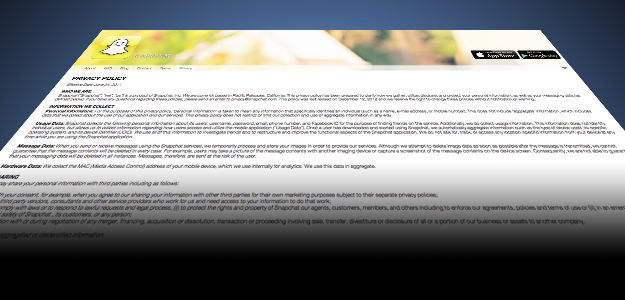
Snapchat’s privacy policy is arguably the more important of its two site governance documents, given that the app is essentially built on the premise that there’s some stuff you would rather keep private. So, what does it say?

What Snapchat collects about you

Snapchat collects your username, password, email, phone number, and Facebook ID “for the purpose of finding friends on the service.” It also collects “usage information,” which the company says is anonymous. This information could be shared with third parties – which isn’t great, but is something you should basically assume is happening at this point.

Can Snapchat see my pics?

Of course, we probably all assume that much. But what about that photo of your freshly showered bum? Can some Snapchat lackey see that? The answer is, I don’t know. The privacy policy states that Snapchat will “temporarily process and store your images in order to provide our services.” But does this mean that some guy at the Snapchat offices can peek in on your pics? Perhaps not – but it’s possible.

The company goes on to say that, “Although we attempt to delete image data as soon as possible after the message is transmitted, we cannot guarantee that the message contents will be deleted in every case.” It then gives an example of someone taking a screengrab of a photo, over which Snapchat has no control.

I have reached out to Snapchat for clarification on 1) whether someone at Snapchat could ever have access to your actual photos; and 2) whether there are any instances in which Snapchat would store images on its servers for extended periods of time. I will update this space with any response I receive on this matter.

Location, location, location?

Another potentially troubling bit is Snapchat’s policy on location data. The privacy policy unequivocally states: “We do not ask for, track, or access any location-specific information from your device at any time while you are using the Snapchat application.”

Great! Right? Well, not so fast. A quick look at the “permissions” required of Snapchat for Android shows shows that the app requests to access you “approximate location,” which is based on “network location sources such as cell towers and Wi-Fi.” This is different than GPS location data, but is still location data.

I have also asked Snapchat to clarify its policy on location data collection. At the moment, it is not against the law for apps to collect location information on users without their knowledge or consent – a pitfall that Sen. Al Franken (D-MN) is trying to fill in with a new bill that just passed the Senate Judiciary Committee on Friday. But until then, we are at the app makers’ mercy. Let’s hope Snapchat has some.



Source : digitaltrends[dot]com

It's free
index