The story so far: A look at where Dead Space is going and how it got there

We recently had the chance to join a roundtable discussion with Visceral Games Vice President and General Manger Steve Papoutsis, who is also the executive producer of the Dead Space franchise. He addressed the concerns about the game focusing too heavily on combat, revealed his favorite product tie-in for the game, and explained why you won’t see “Dead Space 3″ on the Wii U.

You can’t please everyone. This is a lesson anyone in entertainment – or anyone who produces content of any medium, for that matter – has come to learn. When Michelangelo painted the ceiling of the Sistine Chapel, there were likely people that walked in and thought “meh.” We are an opinionated species, and one person’s masterpiece is another’s sloppy graffiti.

So what chance does a video game have, especially one born out the fringe genre of survival-horror? That is a question that the Dead Space franchise has faced since it was first released back in 2008. How do you offer a survival-horror game that can capture the same audience as blockbusters like Resident Evil and Silent Hill, and still attract a mainstream audience that tends to gravitate towards combat-heavy action titles?

The first game in the series put the horror first. It was filled with plenty of scares, scarce ammo, and death around every corner. It had a few pacing problems because of it, but it was generally hailed as a major success; greeted as a viable new franchise, as well as one of the best survival horror titles in years. It was, however, very much a genre game.

For the second iteration, the game had a slightly more combat-oriented slant, introducing larger areas and plenty of ammo. It received as good, if not better, reviews, sold more copies, but also lost some of the fans from the first game. Fear took a backseat to combat, and the threat of a fright gave way to the predictability of an enemy encounter. You could walk into a dark hallway and know that something was going to spring out at you every time. It was still hailed as a great game, but it was noticeably different from the first, and faced criticism for it.

With Dead Space 3, the series has seemingly shifted even further away from the survival-horror aspect and more towards the action-horror. The trailers and clips have shown a much heavier combat emphasis, and there is even a co-op mode that seems to nullify the fear aspect altogether. It is far less frightening to walk into a dark and creepy room when you have a machine gun toting buddy next to you.

That certainly doesn’t mean the game can’t scare you. It just means the impression given off is that horror is secondary.

We recently joined in a discussion with Steve Papoutsis, Visceral Games General Manager and Vice President, and the executive producer on the Dead Space franchise. The first question was, of course, regarding the shift from survival to action – but according to Papoutsis, it isn’t the game that needed to change, but rather our definition of it.

“I don’t really like to categorize Dead Space as survival-horror or action-horror,” Papoutsis said. “Any Dead Space game needs to have these things: it needs to have immersion, it needs to have great atmosphere, it needs to have superior sounds. It needs to have terror, tension, thrills, and yes, action. If you have all of those things, you have a Dead Space game.”

The survival-horror genre has been slowly dying over the last few years. Games like Resident Evil have moved further and further away from their roots with mixed results (see the critical and commercial bomb, Resident Evil 6). Other games, however, like Day 1 Studios’ F.E.A.R. 3 fared better and managed to keep the survival-horror base happy while also attracting more mainstream gamers looking for something new amid a saturated sea of shooters.
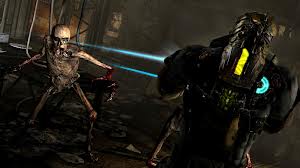
The move also makes sense given the story arc of the series’ protagonist, Isaac Clarke. He began as an engineer with particular skills that helped him survive, but he was not a soldier or fighter. By the time the second game arrived, Isaac was nearly mad following his encounter with the Marker, and his treatment at the hands of EarthGov didn’t help. By the time the third game arrives, Isaac has seen a lot and been through more than nearly anyone in his universe. It makes sense, at least from a narrative point of view, that Isaac would be more of a hardened combat vet at this point. Of course, the game isn’t out yet, and the fear factor could still be very high.

The introduction of the co-op was also not nearly as surprising as most may think, according to Papoutsis, who claims that the idea was first considered as far back as the first game. The thing about the co-op is that you don’t need to play it at all. When you are playing solo, the second character becomes a background character that occasionally shows up as the story dictates, but he is not a computer-controlled ally who joins you. In the single player campaign, you are very much on your own. The co-op is almost like a separate game.

Dead Space 3 intends to further expand the universe Visceral has created. The co-op is simply one more way to do that, and the new character, Sergeant John Carver, represents the surviving EarthGov forces. He is a fully realized character, complete with his own backstory that will be revealed in the game and through other mediums.

“We have a graphic novel that’s coming out soon that really focuses on John Carver’s past, and we have a novel that’s coming,” Papoutsis said before highlighting his favorite tie-in product. “Those are two really important things that we’ve done this time that are fun and fit in with the fiction. And the other thing that I got to see the other day that was absolutely super awesome was the art of Dead Space book that is coming soon, which is really, really, really neat. I was blown away by how nice it looked. It was very, very cool.”

The novel, Dead Space: Catalyst, will be written by B.K. Evenson, the author of the previous Dead Space novel, Dead Space: Martyr. Catalyst takes place two hundred years before the events of the first Dead Space game, and three hundred years in our future. The time and setting will directly tie into Dead Space 3, but to explain how would be something of a spoiler. Needless-to-say, the book will flesh out the game’s narrative.

But even as the universe expands, there is one area the Dead Space team is not planning to go: the Wii U. The previous games were exclusive to the Xbox 360, PS3, and PC, and this game will be no different. Visceral did develop Dead Space: Extraction, a spin-off game exclusively made for the Wii. But even with the added power of Nintendo’s new system the team is not looking to bring the horror to Nintendo’s doorstep.

“With the Wii U, I’m sure Nintendo is going to be successful with that. It’s very interesting, but it didn’t factor into the plans because the game’s controls and the way that it was designed, and where the series has gone, didn’t factor that in,” Papoutsis stated. “So we’re not going to just bolt on that stuff to Dead Space.

“When we did Dead Space: Extraction, that was a Wii game from the start. Everything about it took into account the hardware and how to best deliver on a Wii experience. On the Wii U, it may work, but again, players would feel like we were not utilizing that system to its full extent. It just wasn’t the plan, and we weren’t going to change the plan for it. “

That doesn’t rule out a possible Wii U exclusive down the road, but Visceral is keeping quiet regarding any further plans regarding the franchise. Papoutsis wouldn’t comment on any DLC for the game either, although Dead Space 2 featured several expansion packs, including a standalone chapter with a different character. Odds are Dead Space 3 won’t ignore the lucrative world of post-release content.

It is fun to dream about the future of the franchise, but it most likely depends on the success of this game. EA just released its most recent earnings report, and while the company is well situated for the future thanks to heavy investments in mobile and social gaming, its console software sales bordered on anemic – thanks in no small part to a few high profile bombs, especially Medal of Honor: Warfighter. That illustrious series has been taken “out of rotation,” which could mean the end of one of the oldest franchises around – at least for now. Dead Space has far less clout, so a poor showing could spell serious trouble.

On the other hand, a hit will position EA nicely as the next generation of consoles arrives, and should give Visceral plenty of breathing room to craft another Dead Space for the next generation. And while the game is firmly grounded in its third-person shooter roots, things could always change.

“It would be pretty cool to do all kinds of different things,” Papoutsis said of the future of the franchise. “I could see an awesome open world game, maybe an MMO. An RPG would be pretty sick. Yeah, I don’t know, that’s a fun question, there isn’t one specific thing. I’ll say this though, the story needs to support whatever it is. The story needs to support whatever it is, it needs to feel like an authentic Dead Space game.”

The immediate future of the franchise will be decided soon enough. Dead Space 3 arrives for PC, PS3, and Xbox 360 on February 5.


Source : digitaltrends[dot]com

Ofcom likely to free more 2G/3G airwaves for 4G use

Ofcom likely to free more 2G/3G airwaves for 4G use

Vodafone and Three could get 4G services out of the gate sooner than expected

Ofcom is expected to approve proposals from Vodafone and Three in the UK, which would allow them to use existing spectrum to offer 4G LTE services.

The networks want to follow EE's lead and convert some of the airwaves it is licensed to use for 2G and 3G services into super-fast 4G mobile internet.

The government's communications regulator is now holding a public consultation on the proposals until March 29, with a decision expected shortly thereafter.

A positive outcome would be a massive boost for the networks, who're desperately attempting to minimise the damage done by EE's lengthy headstart on the competition.

Mobile liberation

"This will meet a long-standing objective to liberalize all mobile licenses so that there are no regulatory barriers to the deployment of the latest available mobile technology," Ofcom said in a stamtent on Friday, indicating that a positive outcome is on the cards.

If Ofcom does indeed approve the plans, it would enable Vodafone and Three to launch 4G contracts, perhaps before spectrum becomes available before the long-running auction saga comes to a close.

Seven companies are currently vying for the radio airwaves required to run 4G services in the UK. The bidding process is expected to continue for the next couple of weeks.

A quick resolution is vital for EE's rivals, given that the network was able to roll-out 4G connectivity to nine more UK cities, last week, bringing the total to 27.


Source : techradar[dot]com

Weekly mobile news recap: Winners and losers of Super Bowl week

The Ravens and 49ers meet in the Super Bowl this weekend to determine who is the best team in the league, which means there has to be a winner and a loser. In this week’s mobile news recap, we’ll take a look at some of the winners and losers in different areas of the mobile world.

This weekend is all about one thing: The Super Bowl. The Baltimore Ravens and the San Francisco 49ers show down in the final football game of the 2012 season to determine which team will be crowned champion. It’s three hours of pure intensity and human drama, which provides just enough of a distraction to make us forget about the PED stories, Ray Lewis’ legal issues, and the backward thinking 49ers locker room. While it looks like everyone involved in Super Bowl XLVII is losing at press week, the official winners and losers will be decided on the field. Since mobile companies will be taking part in the real draw of the big game – the commercials - we figure it’s best to take a look at the winners and losers of the past week in mobile. Let’s be honest, you’ll be spending as much time looking at your phone as you will at the TV screen during the game, so you might as well know what’s going on in mobile news from the week of January 26-February 3, 2013.

Apps

Winner: Temple Run 2

There are always new apps coming out. So often, in fact, it’s hard to keep up with all of them. So while new apps are on their way and some of our favorites keep getting better, it’s pretty easy to pick a winner when an app racks up 50 million downloads in just two weeks. Temple Run 2, the cleverly titled sequel to Temple Run, ran into the record books by becoming the fastest growing mobile game ever. Perhaps this is why those birds in that other game are so angry.

Loser: Facebook

The inevitable increase of mobile devices means more and more people are starting to frequent their favorite websites on the go. So it’s a no-brainer that Facebook’s mobile visitor base has increased significantly. The company saw the mobile-only users jump by over 30 million in the 4th quarter. Despite this, Facebook is losing money. Net income is down 79 percent and investors are moving on. Maybe if it didn’t take you forever to fix broken features on those popular apps of yours, things would be better, Facebook.

OS

Winner: BlackBerry 10

Not sure if you guys heard, but BlackBerry released its new operating system – BlackBerry 10 – and some new devices to run it on this week. It might seem like a no-brainer to give the win to the new guy, especially with expectations so low, but we think BlackBerry really earned this one. In true eccentric athlete-like fashion, the company formally known as Research in Motion even renamed itself to signify how serious it is about its new dedication to its mobile product. The Z10 and the Q10 both seem like winners, and the OS has been pretty well received. Welcome back, BlackBerry.

Loser: iOS 6.1

Never one to miss out on a chance to mooch off of someone else’s news cycle, Apple decided to launch the first major update for iOS since iOS 6 was released. Over 300 million users are using the sixth version of Apple’s mobile operating system, but if you’re going to try to get them excited while a competitor owns the spotlight, go big with it. Siri can now order you movie tickets? Great, we can’t wait for it to hear us wrong and get us tickets to whatever version of the Step Up series is in theaters now.

Tablet Market

Winner: Android

The IDC released its latest reports about the tablet market, and its findings aren’t all that shocking. Apple is still dominating, Android is gaining, and those trends are likely to continue. Our winner by default are Android tablets because the internal competition between the biggest players in that market is more interesting than the big picture. Amazon made devices once were the kings of the Android population, but Google’s critical hit with the Nexus 7 has cut into the lead. Now Acer has announced its attempt to take on the biggest players in Android tablets, things could get really interesting.

Loser: Apple

By default, the loser of this report has to be Apple. Yeah, it only lost market share because it absolutely owned the market for the longest time, and statistically it’s continuing to do so. But its share of the pie is shrinking. If Asia is any example, people might be getting sick of Apple. Then again, workers in Asia see under the hood of Apple products. Perhaps they don’t like what they see. 

New Device

Winner: 128GB iPad 4

Alright, we just declared Apple the loser in the tablet market. Are you ready for a contradictory statement? Apple’s supposed 128GB iPad 4 is the winner of the new tablet conversation this week. Why? Because it’s capitalizing on the fact that tablets are becoming used more and more for tasks computers would usually be used for. It’ll have a bigger price tag, sure, but Apple users are used to paying top dollar for their devices. If everything goes according to Apple’s plan, you can pay for that 128GB iPad with someone else’s money.  

Loser: 64GB (but not really) Microsoft Surface Pro Tablet

A bigger hard drive scored Apple a win in this column, so the company that does the exact opposite has to take the loss here. Step up to the plate and disappoint some people, Microsoft! The computing giant confirmed rumors that its Surface Pro tablet will ship with almost two-thirds of its internal storage already in use. The 64GB Surface Pro with 23GB of actually usable storage ships for $900, though we suggest when you go to pay for the device, you offer one-third of your total.

Law Breakers

Winner: Apps that break the rules

Everybody loves a rebel. They break the rules and they do what some of us would like to do but are too afraid to. When we see rule breakers we like stick it to the man and come out on top, it’s hard not to celebrate a little. That’s why apps that break the rules are the winners of this category. The popular new Vine app got away with something that 500px couldn’t: Featuring porn. The guys behind Vine claim it was an accident, and it very well may have, but the app is still around to tell its story, no matter how explicit it may be. Speaking of 500px, it’s back in the App Store. Meanwhile, the popular messaging service Whatsapp is having the legality of one of its features questioned. Keep fighting the power.

Loser: Jailbreakers

A time honored past time for mobile users died this pass week: Jailbreaking your phone is now illegal under the Digital Millenium Copyright Act. The reasons for the decision vary, most of them being uninformed and unengaged lawmakers, but it’s on the books now. Of course, no one’s really sure how anyone plans on enforcing this law. But we’re sure the first time it is enforced, we’ll be hearing an awful lot about it.


Source : digitaltrends[dot]com

Albert Hughes’ long road from beating pimps at NBA Live to filming the Crysis 3 web series

Director Albert Hughes explains why he and his twin brother Allen had to quit video games cold turkey, and what convinced him to come back to film the video series “The 7 Wonders of Crysis 3,” in support of the upcoming game.

Director Albert Hughes is the older half of the Hughes Brothers Hollywood duo, although he’s older by only nine minutes. The Los Angeles based siblings hit a home run in 19913 with their first film, the gritty street drama set in South Central LA, Menace II Society, which paved the way for their followup up, the heist drama, Dead Presidents. After working on the HBO documentary, American Pimps, the brothers reteamed for a mainstream Hollywood adaptation of From Hell, based on Alan Moore’s graphic novel about Jack the Ripper. Most recently, the directing duo partnered with Denzel Washington on the Warner Bros. blockbuster, Book of Eli. Most recently, the duo set a small portion of the internet ablaze with the news that they were working on a live action version of the manga-turned-turned property, Akira. After nearly a year and a half though, the brothers announced that they had left the project, which is now in limbo. 

Following from , the Hughes brothers decided to work on separate projects. While Allen has the 2013 Broken City starring Mark Wahlberg and Russell Crowe, Albert has gone virtual for the first time in his career. He’s been working with Electronic Arts and German game developer Crytek on a Web series for the sci-fi shooter, Crysis 3, which will be released for PC, PS3, and Xbox 360 on February 13. We spoke with Albert about directing “The 7 Wonders of Crysis 3,” and he explains why both he and his brother had to go cold turkey on video games in this exclusive interview.

What are your thoughts are on what they can create with video games today?

I was pretty blown away because I’ve been away from videogames since like the late ‘90s and early 2000s. When I saw the game engine and the cranes they were using when I went to Germany, I was just like, “Wow.” I saw the Crysis games they’ve done and just the lighting alone blew me away and the detail of all the graphics. Then when I went and saw how they were doing it and they talked me through all this stuff, to me it’s very similar, in a way, to what we do with movies. The only difference is the graphics are way more advanced.

They were going to show me little things like how they diffuse the lighting, where the light source comes from and things like that. Even when I was doing pre-vis (pre visualization), I never saw anything like that. It’s a full-blown thing they’ve got going there. It’s like making a movie, and I compare it to pre-vis in that way, but the most spectacular thing is how realistic everything is in real-time.

What impact did the game technology have creatively on allowing you to bring this new Web series to life?

It’s like anything is possible in a way. Sometime it’s a dangerous thing in a filmmaker’s hand, and even a video maker’s hands, when you know you can pretty much do anything you can imagine. If I compare it to an animated movie, sometimes the directors and designers are so excited about technology that they just go ape wild over camera and lighting, and they’re not really using it as a tool.

My whole thing was just let me just look at this like it’s a film and try not to overuse the stuff with a style over substance type of thing by doing all this trickery. Instead, I approached this like it’s a normal cinema camera. Sometimes you’ll get away with more than you will with a camera, but you have to pick and choose your spots and not be heavy-handed about it. That was more of a conscious thing I had to look at when I was doing this.

New Smart TVs offer a big HD screen and online connectivity for Web series.

Yeah. That’s true. I forgot about that because I’m so far behind in my whole personal use of things. I don’t really get into that stuff. I’ve been over to a few friend’s houses’ and I’m like, “Wow, it can actually go on YouTube and watch things on my TV now. But I’m still watching the same 27-inch VCR-TV combo pack that I had back when I was 18.

Finding VHS tapes must be difficult these days…

I haven’t touched the VHS in years, but it’s a TV that had that combination and it’s a mono speaker. My brother is more into the home theater experience. I know how to do it all. I edit in my off time and I know all those tools. But if I want to go see something in its proper format, whether it’s a Web series or a movie, I go to the theater or I go to a big screening room to see it. I’m not trying to keep up to date at home because it’s like trying to keep up with Apple, and you’ll go broke doing that.

What’s the last memory that you have from when you used to play video games?

When I played video games I was more interested in sports games. Why games are so dangerous for me – and dangerous for lots of people in a good or bad way – is that it took up so much time because I wanted to master it. I did master some games. I mastered them so well, that I retired my friends from playing. I would make playbooks for Madden NFL Live. I would print up massive coach-like playbooks and laminate them. I remember running into the room one day with like 10 of my friends and they saw me do that and they wouldn’t [play] us anymore. Me and my brother – we were doing this documentary American Pimp at the time – and we were going all around the country. All the pimps and hip hop guys were into NBA Live and we beat everybody at that game because we would play with a full-on joystick, not a little hand controller. We would play with the old school joystick and that gave us more control over the movements of the players. We’d do this like 12 hours a day nonstop and that’s probably why we didn’t make that many movies during that period.

What did you learn about gaming from that experience?

What I found is if you’re going to be a gamer – and like most gamers out there it’s a professional attitude – you’ve got to go at it for hours and hours and hours a day to get really, really good at it. And we did. We got really good at it, but it took away from the rest of life, basically. That’s the most searing gaming memory to me and I don’t think I want to go back there.

Speaking of professionals, there are actually pro gamers now who get paid to play games.

Are they hired by the companies or are they just playing each other?

There are leagues and they compete in front of huge crowds while others at home livestream the games.

Oh, my god. What a sick world we live in.

What’s next for you after Motor City?

Motor City shut down weeks before I was shooting. It was my late-term abortion, I guess. I was really excited about that one because it was basically everything I learned since I was little put into one movie. It was a movie with no dialog, so it was a strictly visual storytelling. I don’t know what’s next right now because I took a whole month after that. And right now I’m doing this Crysis 3 stuff, which has been going on probably seven or eight months now. At first the involvement was not supposed to be as in-depth. Originally the way it was proposed to me was every week I’d check in and start working on certain things, but what I found out about this Crysis 3 thing, once we started working on it is it’s almost like making a movie. It’s full-on every hand on deck. I didn’t expect that. I thought it was going to be more like a commercial or short film. Right now I’m just reading scripts for the movie, but I can’t really take on anything until I finish this, which I think goes well until after March.

What do you like about working on this Crysis 3 series?

What I do like about this project is how it pertains to movies. In a way it’s like it still sharpens the same skills. I’m able to set camera angles up. I’m able to set blocking, actors, the sound, dialog, the music, and lighting and stuff like that. It definitely hones those same skills.

What’s your favorite piece of technology or gadget and why?

Wow, that’s a hard question.

And it can’t be the TV/VHS combo.

No, it’s not that. It’s for sure not that. I’m learning to really resent that one. It would have to be my laptop. Everybody I know calls my computer my girlfriend. So my laptop and my iPhone, but I’ve got a love/hate relation with the iPhone. I’ve been with Apple since 1982. I’ve been on Mac since ‘89 and Apple is just like crack dealers. I would say it’s my laptop because everything I do when I shoot photos or whatever, I’m in Photoshop or edit with Final Cut Pro or the Web. It’s everything. I’m not a big iPad guy. I think the iPad is like a souped-up iPhone.

What particular Mac do you use?

The one they discontinued, the Mac Book Pro 17 inch. I know I have to upgrade my computer. There’s no CD or DVD drive. It’s just getting crazy out there. I don’t like where it’s going with Apple right now.


Source : digitaltrends[dot]com

Leaked: Mid-Range HTC M4 and Entry-Level HTC G2 Android Smartphones

HTC M4


HTC is getting ready to announce a couple of new Android smartphones and it looks like we’ve got the inside scoop on all of their pertinent features and specs. Neither one of these devices sounds like it’s going to be a flagship, as that spot is being reserved for the HTC M7, but they are approaching the middle and lower tier of the market with the M4 and G2, respectively.

These are just codenames at the moment, so it’s likely that HTC will change the names before an official unveiling and launch. They wouldn’t want to confuse that G2 with an LG Optimus G2, right? Starting with the mid-range HTC M4, it sounds like it’s going to have a 4.3-inch 720p display, backed with a 1.2GHz dual-core Snapdragon and 2GB of RAM. Other specs include the 13MP f/2.0 camera, 1.6MP front facing camera, 16GB storage, 1700mAh battery, Android Jelly Bean and HTC Sense. It’ll come loaded with LTE “where available.”

Approaching the much more entry level end of the market is the presumably affordable HTC G2. It’s quite a bit smaller with its 3.5-inch screen, leading us to believe that this is a replacement for something like the HTC Desire C. There’s a single core 1GHz processor, 512MB RAM, 4GB storage, microSD, 1500mAh battery and 5MP camera. Strangely, it’ll ship with Android 4.0 Ice Cream Sandwich, rather than Jelly Bean.

Both the HTC M4 and the HTC G2, along with more information about the HTC M7, should all be announced to the world at HTC’s event on February 19.


Source : mobilemag[dot]com

It's free
index