BlackBerry 10 L-Series caught in new photo?

BlackBerry 10 L-Series caught in new photo?

Leaky L-Series (credit: N4BB)

RIM is managing to stay relevant and keeping interest in its BlackBerry 10 alive both through official announcements and inadvertent leaks.

While the company likely isn't to blame for a BB10 handset image that surfaced Thursday, it probably appreciates the publicity.

The image in question purportedly shows the L-Series, otherwise known as the touchscreen phone that will cradle RIM's forthcoming OS early next year.

Nothing new is revealed, though the image shows clear frontal detail and the same lock screen found in BlackBerry 10 Dev Alpha A and B handsets.

'It's coming'

RIM has repeated the "it's coming" sentiment surrounding BlackBerry 10 for months now, and on Wednesday announced the OS and accompanying devices are on track to arrive in early 2013.

CEO Thorsten Heins confirmed that over 50 carriers are in the midst of testing BB10 and according to him, response to the new operating system has been "tremendous."

Along with the touchscreen L-Series, RIM is also reportedly preparing a QWERTY-equipped N-Series - will be made publicly available.

Looking back at the L-Series, there's something iPhone 5 about it, so if design set it apart, hopefully BB10 will.


Source : techradar[dot]com

Okami HD review: Amaterasu returns, more beautiful than ever

Okami-HD review

Though it was under-appreciated in its own time, Capcom hopes that modern technology might offer its Okami a new lease on life.

In 2006 Capcom published a PlayStation 2 game developed by Clover Studio called Okami. Though it was one of the last games released for Sony’s best-selling console, Okami was an ambitious project. At that time Clover was known solely for the stylish beat ‘em up series Viewtiful Joe, but with Okami it hoped to marry Japanese mythology and historical art styles with modern gameplay concepts to create a sprawling, epic adventure. As reviews published around the time of the game’s launch will attest, Clover was wildly successful. Critics seemed to unanimously agree that Okami was a masterpiece. Despite all this positive press though, Okami never sold very well. Clover Studio was shuttered by Capcom after releasing only one more game.

I offer this history lesson not just to educate you all on the history behind the game I’m reviewing today, but also so that I can publicly apologize for not having purchased Okami when it debuted. I probably didn’t directly cause Capcom to close Clover down, but after having finally experienced this modern classic I can’t help but feel guilty about how the whole situation panned out.

Okami HDAs with the original Okami, Okami HD tells the story of a world threatened by the demonic hydra Orochi. The opening describes a legend of a white wolf protecting a Japanese village from Orochi at the cost of her own life. Of course, this being mythology, eventually Orochi returns to menace the world again and the wolf reappears to once again defend humanity. Trust me, that introduction sounds a lot better when presented in front of gorgeously stylized sumi-e imagery. By the time you’re actually given control of Amaterasu (that’s the wolf’s name; she’s a Shinto sun goddess), not only does it make perfect sense that you’re now running around as a white wolf with a flaming disk on her back, you’re also absolutely primed to explore this new world and find some way to stop Orochi.

Old Dog, New Tricks

While Okami has always been a gorgeous game, it was released more than half a decade ago on a console now considered “last gen.” Thus, as we’ve seen in other recent high definition remakes like the Ico & Shadow Of The Colossus Collection, Okami had to be equipped with new, modern features that simply didn’t exist when it was initially developed. These new accoutrements include the standard things you see in all PlayStation Network releases (like Trophy support) but the two most important additions to the game are definitely its new high-definition graphics and Okami HD’s support for Sony’s Move peripheral.

Retrofitting older games with high definition graphics isn’t anything new. Unfortunately, it’s also rarely as impressive as you might hope. Most developers, when converting a PlayStation 2 title to the increased graphical specs of the PlayStation 3, simply boost a game’s resolution, which is helpful but does nothing to improve the textures used in the game that were originally created at the lower PlayStation 2 resolution. Actually, the increased resolution can often highlight these shortcomings, making an HD version less attractive than its original iteration. To Capcom’s benefit though, the sumi-e art style used throughout Okami almost completely masks any glaring issues that would instantly give Okami HD away as a PlayStation 2 title. I won’t say that Okami HD looks good compared to the other big-name releases hitting store shelves this year, but it could very easily pass as an Xbox 360/PlayStation 3 title from as recently as two years ago. If you’ve never played Okami before, know that Okami HD is gorgeous. If you have played Okami before, you already know that the game is gorgeous, but trust that the high definition improvements are even better than you might have hoped.

Unlike the newly improved graphics, I’m of two minds on the implementation of Move support in Okami HD. The Move support itself works perfectly. Controlling the Celestial Brush (long story short: Amaterasu can alter reality by painting on it; this is one of the core game mechanics in Okami) is quite simple with the Move, as long as you have the system set up correctly. Although Okami was developed long before Move, the Celestial Brush mechanic just so happens to perfectly suit Move. It’s quite comfortable to use the Move controllers during gameplay, the motion control is as intuitive as you could possibly want it to be, and if you prefer not to use it, the feature is never forced on you.

Okami HD

Despite its impressive functionality though, I just can’t see why anyone would ever want to play through the entirety of Okami HD using those day-glo wands. I played the game for a few hours using Move and while I will admit that the addition has some novelty at first, it quickly made me wonder why I was flailing my limbs when it was far more comfortable and familiar to perform the same actions via a traditional controller. It’s sad that I have to criticize a game for a feature that absolutely works, but in this case Move is, at best, a gimmick with very niche appeal.

A Link To The Past

Beyond those new additions, Okami HD features the same classic gameplay found in its predecessor. And, it should be said, in all of Nintendo’s recent Legend Of Zelda games. 

It’s never been much of a secret that Okami’s gameplay was directly inspired by and/or an homage to Nintendo’s franchise. Okami HD features essentially identical gameplay to its predecessor, so the Legend Of Zelda influences are also prominent in this game. As in the modern, 3D Legend Of Zelda titles Okami is largely an adventure focused on whimsical fantasy, acquiring new abilities to enter new areas and getting to know the eccentric locals you meet in your journey. Combat is real-time but relatively simple (the Celestial Brush doesn’t complicate battles as much as you’d expect), the story is alternately epic and humorous, and enemies are suitably puny/impressive/horrifying as the situation dictates.

Normally I’d slam a developer for so blatantly lifting design cues from another developer, but if you have to swipe ideas you may as well swipe from the best. Plus, the results speak for themselves: Okami is a thrilling adventure that is not only inspired by The Legend Of Zelda, but also stands alongside some of its best entries in terms of sheer entertainment value. Since it’s anyone’s guess when Nintendo might release a proper Legend Of Zelda sequel on the Wii U, Okami HD is the best way for fans to get their action-adventure fix.

Okami HDConclusion

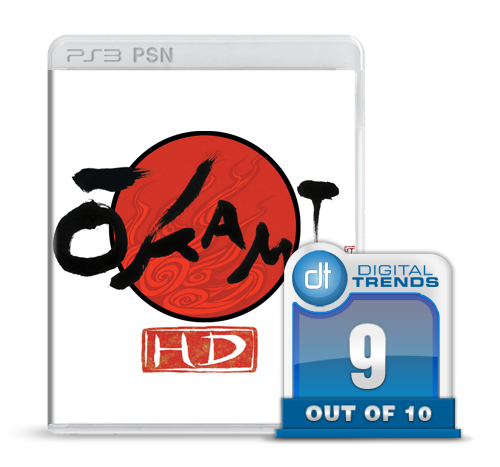
Subjectively I want to give Okami HD a perfect score. Not because of my latent guilt over the closure of Clover Studio, but because the firm’s biggest game was also a gorgeous, engaging adventure that is only improved by the thick coat of polish seen in Okami HD. That the game is being sold for $20 as a convenient digital download only improves the already fantastic offerings here.

Objectively though, as I said, while Okami looks great it’s not quite up to modern standards. Graphics certainly aren’t everything, but there are a few other issues caused by the game’s age. They’re minor to be sure (save points are occasionally too scarce, controlling the camera with the right stick takes a bit of getting used to), and are certainly just the result of game design conventions gradually changing over time, but taken as a whole these issues prevent Okami HD from earning a perfect score.

Still, I can’t recommend this game more highly. $20 is a phenomenal bargain for the grand adventure that is Okami HD.

Score: 9/10

(This review was written using a downloadable copy of Okami HD provided by Capcom.)


Source : digitaltrends[dot]com

AT&T, T-Mobile partner up to share networks for affected Sandy customers

cell towers

Those having trouble finding signal in the wake of Hurricane Sandy will be glad to know their coverage is now temporary expanded thanks to a T-Mobile/AT&T partnership.

Those in New York and New Jersey may have experienced a shortage in network over the past few days in the wake of Hurricane Sandy, so cell providers T-Mobile and AT&T have decided to put their rivalry aside to offer customers extra coverage. The companies have just announced that they will be joining forces to share their networks for the affected NY and NJ areas to help those having difficulty in their search of a working signal.

AT&T and T-Mobile customers would not have to sign up for any extra features to enable the functionality. Instead, they can go about using their phones as they normally would, and hopefully the added coverage will help provide a wider range of network. The shared network agreement is possible since both companies rely on similar GSM-based networks, and data charges will still be billed to the provider that user is originally under regardless of which provider allotted the signal during the duration. Theoretically, if your phone receives both the signal from AT&T and T-Mobile networks, it will run on whichever signal is stronger.

No words on when the temporary arrangement will last, but this is a compassionate act by both AT&T and T-Mobile to offer a little bit of help while they can. As of today, there is still no power in areas below 34th street in New York City. Limited public transportation service has been reinstated, though buses are not running downtown after nightfall due to the lack of street lights, making it a “dangerous condition” for commuters and local residents. Although Con Edison recently announced that approximately 225,000 customers have had their powers restored,  the rest of Manhattan will have to wait until Friday or Saturday to be back up in lights.


Source : digitaltrends[dot]com

Windows Phone 7.8 release date detailed again

Windows Phone 7.8 release date detailed again

Windows Phone 7.8 - tile time

You might not be getting Windows Phone 8 on your old handset but the consolation prize is Windows Phone 7.8, and it looks set to land just after the new OS goes on sale.

According to a post on Facebook, we'll see Windows Phone 7.8 land shortly after Windows Phone 8 devices go on sale in November – which jives nicely with the information a Chinese blog came up with yesterday.

It also lists just a couple of upgrades you can expect to see, including a "new Start screen", which we've already seen is more in line with Windows Phone 8.

There will also be nifty new services like Xbox Music and SmartGlass.

It was the Italian Windows Phone team that posted the new slivers of information to their official Facebook page, although it's since been taken down.

Screengrab

Happily, Plaffo.com managed to save a screengrab before it was removed, which, when translated, reads:

"'The upgrade to 7.8 will be available for versions 7.0 and 7.5 shortly after the marketing of the devices Windows Phone 8.

"Among the features there is the new Start screen, the sharing of the calendar using the function Club and access to key services and content Microsoft, including Xbox Music Store library that can be enjoyed by Zune and Xbox SmartGlass."

As with most software upgrades, exactly when existing Windows Phone 7 devices will get the update will depend as much on your network as what manufacturer made your device.

Still, we'd expect to see the roll-outs starting from the end of November, but we'll endeavour to find out more and keep you posted.


Source : techradar[dot]com

8 things you think you own, but don’t

8 things

The rise of digital goods and software-reliant gadgets has thrown a wrench in the contemporary concept of ownership. Here are eight products that, even though you paid for them, aren't entirely yours.


This week, the U.S. Supreme Court heard arguments in a case called Kirtsaeng v. Wiley, which will test the limits of something called the “first sale” doctrine. First sale is the legal doctrine that governs our right to buy, sell, and loan things like CDs, books, DVDs, and any other product that is covered by copyright without first having to obtain permission from the product’s copyright holder.

If the Supreme Court sides with textbook publisher John Wiley and Sons, which sued Thai-born student Supap Kirtsaeng on copyright infringement grounds for buying the publishers books in Thailand and selling them to U.S. college students at a profit, you may no longer be able to freely buy or resell used, copyrighted goods. It could even put a stake through the heart of companies like eBay, Amazon, and Craigslist, all of which deal heavily in the sale of used goods.

Regardless of the outcome of Kirtsaeng v. Wiley, a decision for which is expected in June, there appears to be broad confusion among consumers about what “ownership” really means these days. So, in the spirit of clearing things up, here is a quick rundown of the products that, even though you paid for them, aren’t entirely yours.

Smartphones

While it’s currently legal to buy or sell a used smartphone, the law says you may not necessarily do whatever you like with the device. According to the most recent round of exemptions to the Digital Millennium Copyright Act (DMCA) from the Library of Congress, smartphone owners will soon no longer be allowed to unlock their devices for use overseas or with another wireless provider, unless their current carriers give them permission to do so.

Tablets

Unlike smartphones, which may be jailbroken for the purposes of installing apps not approved by the respective app marketplace, tablets are not exempt, according to the new DMCA rules. The reason being: Jailbreaking requires making changes to the device’s firmware, which is currently a copyright violation, at least when tablets are involved. So, why is it allowed for smartphones and not tablets? Two reasons: First, the U.S. government says the definition of a tablet is still too broad to write in an exemption for devices that fall under that name. Second, because tablets are less widely adopted than smartphones, copyright holders were able to convince the government that adding an exemption for tablet jailbreaking would adversely affect the devices.

In short, if you have an iPad, you’re only allowed to install apps from the iTunes App Store. Try to jailbreak it, and you’ve broken the law.

Kindle e-books

If you think you just bought that Kindle e-book, you’d be wrong. You licensed it – a concept everyone needs to be familiar with these days. Amazon’s Kindle Terms explicitly state that “Kindle Content is licensed, not sold,” and that, “you may not sell, rent, lease, distribute, broadcast, sublicense, or otherwise assign any rights to the Kindle Content or any portion of it to any third party.”

The control Amazon has over your Kindle e-book collection came under intense public scrutiny last week after a woman named “Linn” alleged that the company had shutdown her Amazon account and deleted the entire contents of her Kindle e-reader due to some suspicious activity linked to her account. Amazon later stated that “account status should not affect any customer’s ability to access their library.” But Linn is not the only one who has experienced similar loss of access.

Music

Just like e-books, “purchasing” a song on, say, iTunes does not mean you’ve bought the song itself. Instead, you’ve paid for the right to play that song in your personal life (provided your “personal life” doesn’t involve playing songs for large groups of people). Furthermore, it is – believe it or not – against the law to burn a copy of a song you “purchased” onto a CD, or to give a licensed MP3 file to a friend.

In terms of being able to resell music you’ve paid for, things are even more complicated. A company called ReDigi is currently being sued by Capitol Records for giving users the ability to resell their MP3 files, just as used record stores sold, well, used records. This, despite the fact that ReDigi’s technology automatically deletes the seller’s copy of a song or album when it goes up for sale. And no copies of a track are made — the actual file is transferred from one machine to the other, which the company says is a perfectly legitimate way to resell music. Capitol, of course, disagrees.

Movies and TV shows

Movies fall into the same category as music and e-books. As such, making copies of a DVD, or ripping a DVD so you can watch it on a device that does not have an optical drive, are violations of copyright. Now, if you’re copying DVDs on a small scale, just giving a copy to a friend or relative, then there is little chance that you’ll get served with a lawsuit from the MPAA. But not getting caught and being allowed to do something are, as you likely realized by now, two entirely different things.

Oh, and if you’re wondering, the whole “licensed, not sold” thing goes for digital movies purchased through Amazon, iTunes, and other online digital movie marketplaces, too.

Video game consoles

As with tablets, it is perfectly legal (for now) to resell your used Xbox or PS3. What you may not do is mod your video game console (or handheld gaming device) to run an alternative operating system due to copyright on the device’s firmware. Furthermore, jailbreaking your Xbox (or other console) is also forbidden because, according to the Library of Congress, “video games are far more difficult and complex to produce than smartphone applications” and anti-jailbreaking mechanisms are in place to “protect highly valuable expressive works.”

Apps

Don’t even think about trying to give away or resell any of your mobile apps. Not only is this technically difficult, both Google Play and Apple’s iTunes App Store – the two largest online mobile app marketplaces – firmly forbid the reselling of your apps. According to the Google Play terms of service, customers are not allowed to “copy, sell, license, distribute, transfer, modify, adapt, translate, prepare derivative works from, decompile, reverse engineer, disassemble or otherwise attempt to derive source code from” purchased apps. And Apple goes even further, saying that customers may not “rent, lease, lend, sell, transfer redistribute, or sublicense the Licensed Application,” and must “remove the Licensed Application from the Mac Computer or iOS Device” before reselling the device.

Pre-loaded devices

Which brings us to our final item: Pre-loaded devices. Because of the copyright rules governing e-books, movies, e-books, apps and other software, selling a device that already contains these copyrighted items means you would likely be in violation of intellectual property law were you to do so. So if you were thinking about offloading your old iPod with 40,000 songs already on it to your mom’s best friend, just make sure the RIAA doesn’t catch wind of your little scheme, or you could be in hot legal water.

Image via Borys Shevchuk/Shutterstock


Source : digitaltrends[dot]com

It's free
index