MasterCard to release credit card with display and keypad in 2013

Near Field Communication has been at the forefront of payment technology for a couple of years now. We’ve seen the tech ship on multiple smartphones to facilitate paying for things at places like gas stations and convenience stores. A new technology from MasterCard being unveiled in Singapore, however, could rival NFC in sheer terms of awesomeness.

The credit card company worked with Standard Chartered to launch what is essentially a credit card with a built-in display and touch-sensitive keypad. It’s described as an interactive payment card, or security token card, which uses MasterCard’s Display Card technology.

The display and keypad allow cardholders to generate a one-time password that is used as an authentication security measure. MasterCard says that future revisions will be able to display things like available card balance, loyalty or reward points, recent transactions and other interactive information.

The card will become standard issue for all Standard Chartered Online Banking and Breeze Mobile Banking users starting in January 2013. They say it’ll be particularly useful for high-risk transactions like payments or transfers above a certain amount or when adding third party payees.

Furthermore, all MasterCard Super Salary, XtraSaver and Bonus$aver debit cards issued in Singapore will be converted to Display cards. The company didn’t mention if this technology would soon be introduced in other parts of the world.

Would you be more inclined to use something like this to pay for goods versus an NFC-enabled device given the potential security risks that the latter may have?


Source : techspot[dot]com

Sam’s Club offers up the Samsung Galaxy S3 for just 96 cents

Want to get the Samsung Galaxy S3 on the cheap? Now is your chance. It seems that Sam’s Club is offering the Galaxy S3 for just 96 cents on Black Friday.

As expected, the smartphone will require a two-year service agreement, though the ad doesn’t clarify if you get to choose the carrier or if this promo is for a specific cellular service provider. Unsurprisingly, this deal is not available over the net and requires you to go the stores yourself. It is also worth noting that this is Sam’s Club so you will need a membership. If you want a new Android smartphone this holiday season, Black Friday is generally the day to get it— if you don’t mind camping out and fighting lines.

What do you think, will you attempt to camp out at Sams’ to get your hands on the Samsung Galaxy S3 for just 96 cents?

[ Source ]


Source : mobilemag[dot]com

Sprint buys PCS spectrum, half a million customers from U.S. Cellular

Sprint has agreed to purchase spectrum and more than half a million customer accounts from US Cellular as part of a $480 million cash deal. Select customers in Illinois, Indiana, Michigan, Missouri and Ohio are included in the transfer according to a press release from Sprint.

The company will acquire 20MHz of PCS spectrum in the 1900MHz band that covers customers in areas of the Midwest like Chicago, South Bend, Indiana and Champaign, Illinois. Sprint will also take ownership of 10MHz of PCS spectrum located in the St. Louis market.

The wireless carrier plans to use the newfound spectrum to supplement coverage in some areas as part of their continued rollout of Network Vision and 4G LTE nationwide.

In total, 585,000 US Cellular customers will end up as Sprint customers, or roughly 10 percent of their total customer base. The release notes that US Cellular customers outside of these markets will see business continue as usual.

Sprint has been extremely active in the past month or so. The wireless carrier made headlines in mid October when Japanese provider SoftBank acquired a 70 percent stake in the company for a cool $20.1 billion. That deal is expected to be finalized by mid-2013.

Fast-forward just a few days later and Sprint announced they were buying a controlling stake in Clearwire in a deal valued at $100 million. Most seem to think that SoftBank coaxed Sprint to gain control of Clearwire instead of them having to do it on their own.


Source : techspot[dot]com

Qualcomm's in the money as Snapdragon provides a record year

Qualcomm's in the money as Snapdragon provides a record year

Snappy snaps

With 2012 proving a record-breaking year, Qualcomm's smartphone-powering Snapdragon chips are keeping the company's bank vault nicely stocked with cash.

In its financial year 2012, Qualcomm's revenues were up 28 per cent, its operating income was up 13 per cent, its net income was up 43 per cent and, we hate to sound like a broken record, but its earnings per share were up too.

As a result, the company raked in a net income of $6.11 billion for the year. That's about £3.8 billion or AU$5.9 billion.

Lend us a fiver

It's looking a touch less rosy in the quarter-based results, with income for the final three months of Qualcomm's financial year up only 5 per cent – although, crucially still up.

As tech waves go, Qualcomm is riding a good one with its CEO Dr Paul Jacobs attributing the huge cash harvest to the explosion of wireless data and the smartphone market.

It won't stop there, either, with Dr Jacobs saying that he expects "double-digit revenue growth in fiscal 2013" as a result of a robust Snapdragon and 3G/LTE roadmap. In English? More money coming next year.


Source : techradar[dot]com

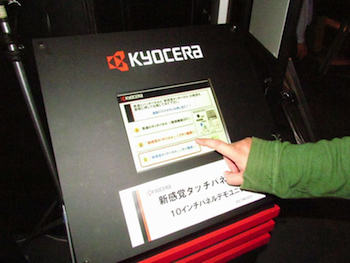
Kyocera demonstrates new touchscreen that feels like it has physical keys

Kyocera touchscreen

Kyocera has demonstrated a touchscreen that it's claimed, feels like touching a physical keyboard. Using similar technology to haptic feedback, it can be adjusted to provide a different feel depending on what you're touching on screen.

Japanese technology firm Kyocera has come up with a new touchscreen, which it demonstrated at the Digital Contents Expo in Tokyo last week. It uses similar technology to that which gives us haptic feedback, and when described, may remind you of Research in Motion’s SurePress technology seen on its Storm phones.

As fans of SurePress are a rare breed, and haptic feedback regularly splits opinion between phone users, this may not sound overly enticing. However, in reality, it’s considerably more exciting than both.

Designed to provide a more tactile typing experience, Kyocera uses piezoelectricity to vibrate the screen at a very high speed when you touch it with your finger, which apparently provides a feeling that resembles touching a physical key.

The clever part is it can be adjusted to make it feel like you’re clicking a button, or gently caressing a soft-touch keyboard. A reporter who tried the system described the softer feel as like pushing down on bubble wrap, and that when pressed, webpage hyperlinks felt as if they were ever so slightly being pushed into the screen. The report also stated that buttons “felt like the real thing.”

Kyocera hopes to implement its new screens on a variety of devices, from smartphones to in-car displays. The increased tactile response and positive feel will certainly help with using touchscreens in the latter.

The benefits don’t stop there either, as it’s expected to help improve typing accuracy on smartphones and tablets, plus it should have some intriguing uses in touchscreen gaming, where the lack of physical keys makes some games not only more awkward, but less satisfying too.

There’s no information on when — or even if — Kyocera’s screen tech will find its way on to a mainstream gadget, but it’s a safe bet we won’t be seeing it on the iPhone 6 or Galaxy S4. Kyocera make a variety of quirky phones, so if it’s going to appear anywhere, we’d imagine it’ll be on one of those first.


Source : digitaltrends[dot]com

It's free
index