Best app updates of the week

Apps that just hit the market are always appealing because they're new and exciting, but some of the old standard apps are getting updates that keep them ahead of the competition. We take a look at the biggest and best app updates to come available this week.

There are a ton of new apps leaking into every app marketplace, trying to vie for position and make itself a contender in its respective category. This gives existing app creators good reason to keep up with updates and offer up new features whenever possible. We see tons of new updates becoming available every week, and its easy for them to pass by without much notice. Here’s a collection of updates that you won’t want to skip. 

Skype for Android (Version 3.0)

Smartphone owners that default to Skype for video or audio calls aren’t going to notice any changes right when they open up the application, but odds are good a sudden understanding will strike during a crystal clear call. Skype has reworked some of the internals of its app, adding a new SILK codec that is designed specifically for the human voice and optimizing call quality based on connection speed. A new login option for Microsoft account users has been added in preparation for Skype’s takeover as Microsoft’s default chat option. Finally, tablet users will enjoy a new layout that makes use of all the screen space available with a two column layout. Seven-inch tablet owners beware, though, as Skype 3.0 locks into landscape layout while your camera likely requires a portrait alignment. It can create for some neck pain.

Runkeeper for Android (Version 2.14.1.1)

Runkeeper serves to encourage people to keep running, which is no easy task. Now in its latest update, its encouraging running with a partner, even if it’s just digitally. Social features like the Friends tab now offers interaction between you and your fellow cardio-centric friends. Facebook integration will bring your contacts to you, and there’s an in-app messaging system that allows you to send words of encouragement–or taunts–to your friends. Your friends will also show up on a leader board, creating a little competition for your circle of runners. The activities page has also gotten an update and a new tab-style navigation system will help users get around in the app.

Amazon for iOS (Version 2.3.1)

Tis the season to do your shopping. That’s what Amazon believes at least, as its latest app update is focused on giving consumers more access to enticing offers. The latest iOS update for Amazon, version 2.3.1, brings push notifications for item shipping and arrival times, letting users know exactly where their purchases are. There’s also a daily alert option that will give you Amazon’s listing of Lightning Deals for that day. The iPad version of the app also got a nice new feature, allowing users to check out product images and descriptions up close with a pinch and double tap to zoom feature.

Nokia Transport for Windows Phone 7 (Version 3.1 beta)

Not content with launching a brand new iOS app, Nokia decided to do some tweaking to its existing apps as well. The improvements come to beta version 3.1 for its Windows Phone 7 app, Transport. The app has always been designed for the commuter in mind, and now a segmented map will make navigation easier. More detail will be available in each individual leg of a journey, so users can get a closer look at their surroundings in the app. There’s also a new countdown feature that will let public transportation users know when the next bus or train is scheduled to arrive. It essentially does what Transport (also known as Transit) 3.0 does on Windows Phone 8 devices but on an older operating system.

Sparrow for iOS (Version 1.3.3)

Sparrow users that own an iPhone 5 can finally get proper use from the email app, as version 1.3.3 for iOS optimizes the app for the iPhone 5′s bigger display. Further improving the app is a feature that allows it to open Passport-specific documents. Essentially, the update brings Sparrow up to speed for iOS 6 and makes it completely compatible with the latest offering of Apple devices it calls home. The email client has been neglected a bit by its owner, Google, since being purchased in July of this year, so the sudden attention is welcome and will hopefully continue.


Source : digitaltrends[dot]com

LG Nexus 4 Users Report Buzzing Noise and Distorted Calls

While the LG Nexus 4 has sold extremely well and received a ton of positive feedback, it seems that it isn’t without a few problems as well. New reports are starting to arise regarding Issue 39936 on Google’s website, which pertains to listening to an earpiece on the Nexus 4. More specifically, so far 135 users claim that while using an earpiece, there is a very faint buzzing and clicking.

Clearly, given that more than 135 people bought a LG Nexus 4, it is not affecting everyone, at least not enough to complain about it. However, after you just shelled out $300+ any little bug is annoying enough.

The main concern seems to be that the sound is coming from the earpiece which sounds like it is always on. Therefore, battery drain could become a problem with this part of the phone running 24/7. So far Google has yet to address the problem, even on the forum. This leads us to believe that the issue is minor or Google has already begun work on a fix.

With the Nexus 4 currently out of stock and ‘coming soon’ back to the Google Play store, hopefully Google and LG will be able to work out a quick fix. Usually, problems as small as this stem from software and not manufacturer error by LG. Are you experiencing buzzing or other noise problems with your Nexus 4? Let us know in the comments below and report it on the Android Issues website here.


Source : mobilemag[dot]com

Nokia's ex-imaging chief heading to Jaguar Land Rover

Nokia's ex-imaging chief heading to Jaguar Land Rover

Damian Dinning seeking a new start

Nokia's outgoing head of imaging already has a new job lined-up. He's on the way to Jaguar Land Rover.

Damian Dinning left his post as lead programme manager for Imaging Experience after eight years, late last week.

In his new post, Dinning will be working on connected cars, which is quite the career change from perfecting cameras in mobile phones.

He said in a statement: "At a very young age, I had two very strong interests, cars and photography. With regards to the latter, I wanted to be able to take photography from the nerdy or for special occasions only use it was at the time, to being part of everyday life.

"I never thought I'd be able to play a role in making that happen, but my time at Nokia gave me exactly that opportunity. I really feel I've been able to fulfil that ambition.

Different area

"Whilst we're really only just entering the next major stage in the development of photography and I still have a very clear vision of how I see it's longer term development, I fully recognise this is the perfect opportunity for me to work in quite a different area."

Dinning, who oversaw the launch of the headline-making Nokia 808 Pureview handset and the Windows Phone 8 Nokia Lumia 920 cited personal reasons for his departure.

Nokia was intent on moving him to Finland as it sought to relocate key positions. Dinning said he was not on board with that decision.

You can read Dinning's full statement in the post on the PureViewClub blog, linked in the hat-tip below.


Source : techradar[dot]com

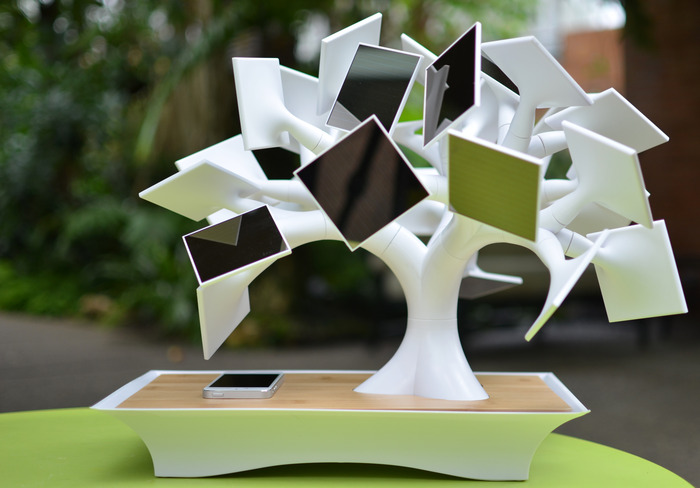
Charge up your smartphone with the solar-powered bonsai Electree+

Electree+ solar charging

Possibly a great way to keep gadgets charged without increasing the power bill, the Electree+ solar charger combines cool design with green technology.

Recently launched on Kickstarter, the Electree+ is a small, bonsai-sized tree sculpture with solar panels attached to the ends of each white plastic branch. The 27 silicon solar panels on the Electree+ are adjustable based on the placement of the device and the direction of sunlight. Ideally, the device should be placed in an area that’s always in the path of sunlight during the day. According to the creator of the Electree+, it takes a day and a half to completely charge up the 14,000mAh internal battery to full power. 

electree chargingHowever, if someone simply wants to recharge their smartphone, the Electree+ can collect enough power to accomplish that task in approximately four hours.

When the battery has a full charge, the Electree+ can recharge an Apple iPad 2 twice, a Samsung Galaxy S III seven times or an Apple iPhone 5 nine times before requiring more sunlight to fill up the battery again. The Electree+ comes with two USB ports for recharging digital cameras, tablets, laptops, smartphones, wireless headphones or any other form of portable electronics. 

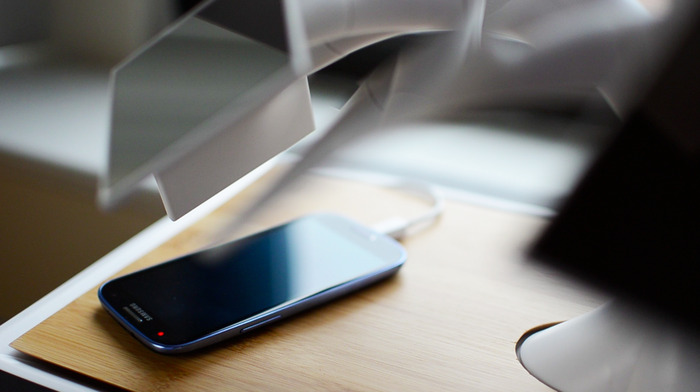
In addition, the Electree+ includes a Qi wireless charging zone underneath the tree to avoid having to search for the correct USB charging cable. iPhone owners can also take advantage of wireless charging assuming they purchase a Qi-enabled case. Beyond wireless charging, an Electree+ owner can upgrade the device with a NFC chip that can be used to trigger specific actions when a NFC-enabled smartphone is placed on the Electree+. For instance, when an Electree+ owner returns home from work and places the smartphone down on the charging area, a text message could automatically be sent to family members notifying everyone that they are home. 

electree smartphoneWithin the base of the Electree+, the battery is stored underneath the baseplate and acts as the base of the tree design. After the plastic trunk is attached, the user attaches the three main branches that each house nine solar panels on smaller branches.

Since the two USB ports are underneath the baseplate, the creators of the Electree+ have designed the plate to allow for two USB cords to exit the device in order to reach a tablet or smartphone. According to the creator, the Electree+ will come in multiple colors and the baseplates will come in multiple colors. 

Regarding the production schedule, the team building the Electree+ plans to use January 2013 to make small tweaks to the design before submitting the design specifications to a manufacturer based in the United States. During February and March, the team will be working to the manufacturer to perfect the prototype and complete the final molds before authorizing full scale production of the Electree+. During April 2013, the team will perform quality assurance tests on the device and make sure wireless charging works correctly. 

The team plans to ship the Electree+ solar charging device to Kickstarter backers during May 2013 assuming the full $200,000 is raised. The minimum cost for an Electree with wireless charging and NFC capabilities is $260. Anyone that wants color options will have to pay at least $325 for the solar charging device. 


Source : digitaltrends[dot]com

Gearbox Software president Randy Pitchford on Aliens: Colonial Marines and the future of game consoles

Digital Trends sits down with Randy Pitchford to talk about developing a proprietary engine to bring the world of Aliens: Colonial Marines to life. Plus: Gearbox's president on the future of video game consoles.

Randy Pitchford had a good year. In the thirteen years since founding his studio, Gearbox Software has never had a hit quite like Borderlands 2, one of the best selling and widely praised video games to come out in a very crowded year. What’s more his studio’s long labor of love, Aliens: Colonial Marines, is just three months away from release after a nearly six year development. Where some game makers are itching for the next console generation to start so it can ramp up the declining console market, Pitchford and his team of creators are sitting pretty.

Digital Trends caught up with Pitchford at a recent event to talk about the prolonged development of Aliens, the unique technology powering that game, and the future of how we play video games.

Aliens: Colonial Marines uses a new engine. Why? Why not use something simple like Unreal Engine 3 to speed up development?

We haven’t really talked about it much, but we made a proprietary lighting engine for this game. Even though we’re at the end of this console generation, because this is a deferred rendering engine it’s going to give us a good sense of what next gen games are going. Deferred rendering is the future. We do leverage Unreal for the architecture and the data sets, for a lot of the under the hood stuff, but in terms of graphics, that’s the stuff we created just for this.

The Aliens films, to do that authentically, we needed deferred rendering. We needed dynamic lights and shadows. In the current generation, for games without a non-deferred renderer, all of the lighting is sort of baked into the environment which means it’s static. Things can’t move. Now take the scene in the Sulaco: There are so many things shifting around, with crates sliding across the room, ship rocking and lolling. If things move, the lights all need to work. When stuff’s blowing up, when you’re on the surface of LV-426, the atmosphere is alive. We needed that to feel natural, so we needed the lighting to be rendered in real time with the game. If you think about some of the other stuff we’re doing like Borderlands, it has a totally different look and feel. Our Brothers in Arms franchise, it’s a totally different environment and feel. Aliens has a very unique art direction, so it demanded custom technology.

You said the team met with Ridley Scott to discuss doing the game before it went into production. When did that meeting happen?

I think that was May of 2006. Maybe 2005.

At what point in the past seven years then did you decide to build this unique technology?

The meeting was 2005 or 2006, but the deal didn’t happen for another year or so after that.

gearbox software presidentThat’s when Sega announced it had the Alien franchise license.

We hadn’t even written the first line of code and Sega was so excited that they and Fox had to turn around and put out a press release! (laughs) It was a business statement, but if you’re an Aliens fan like me and you hear, “There’s going to be a sequel to the movies as a video game and Gearbox is making it!?” suddenly there’s this expectation. I want that now! Usually when we make a game, we’ll be all the way through pre-production and into production before an announcement is made.

It was after our prototype, after our pre-production, that John Cavanagh, one of our programmers, took on the task of building the new renderer for this game. I believe we’ll be using this technology for a while. It’s going to be very useful in the future.

So that was the end of 2008 when we started making that technology and it was probably finished by the end of 2010.

Speaking of 2008, that was when you announced that Battlestar Galactica writers David Weddle and Bradley Thompson would be working on Aliens: Colonial Marines. What role did they play?

Those guys are awesome! We had a framework and sketches of characters when we started the game. Those guys came in and wrote all of this material that brought the characters to life for us. So now we don’t have to think about what we want the characters to be, we think, “Okay, in this situation, how would Bella react to this? What would Winter say?” We know the answer because those guys helped us flesh everything out. Amazing, amazing work. They wrote enough material that we could have an entire series of television, honestly. I loved working with them. [Gearbox writer] Mikey Neumann was able to work very closely with them, and he was able to adapt what they did and write it to a video game, which is very different than writing for a passive movie. The quality that we’ve gotten in the narrative was the result of that iterative process and David and Bradley were instrumental in that. It was so cool to work with them.

I’m not sure if you’re office is still like this, but I saw a picture of it once and the game console collection on display in there is impressive to say the least. You clearly love this old, devoted technology. Aliens, Borderlands, all of Gearbox’s games really are clearly built as multiplatform games, both PC and console. My question for you: What’s the future of the console? Do we need them anymore?

How far in the future are we talking about?

Say fifteen years.

Obviously power is great. There are two components to this. One is energy drawn from whatever source you get it from. In fifteen years, wireless power still won’t be ubiquitous. We’ll be experimenting with it in fifteen years and some people will probably have appliances in their garages that allow their cars to charge wirelessly, but we won’t have ubiquitous wireless power for all devices. So in fifteen years, we’ll still see an advantage in things that can plug into a wall, a devoted power source, and draw a tremendous amount of energy.

The more energy we can draw, the more fuel we have for computing power. Computing power takes energy. Computing power will always allow us to simulate things, whether it’s visuals or gameplay or logic or physics. The more computing power we have, the more robust that simulation will be. Within fifteen years, we’ll still be using our senses—touch, sight, sound—to consume that simulation. So the processing power we’ll be using will still be simulating something that reaches us through our normal senses. We won’t be at a point where our senses can be tricked into something that’s like the holodeck or when something’s plugged right into our brain, where there’s no interpretive layer between the simulation and perception, that’s not going to happen yet.

Within that construct, power will still be a factor and power will let us do all kinds of things. We’re going to see some new fronts in the next fifteen years that are kind of difficult to imagine when you just think, “Okay, I’ve got a dedicated machine, I’ve got a portable thing that uses a battery like a phone or handheld, I’ve got large format stuff like in a movie theater.” You’re going to see that whole spectrum, and it will largely be the same. It will be an iteration of how we understand entertainment, but it’ll be a massive iteration. You’ll see between twelve and twenty-four times the complexity possible on today’s machines.

Today, though, what does having your game on a console give you? What’s the benefit of the technology?

One of the advantages that consoles have for a customer is that you can trust it. It’s a simple price, an entry point that’s accessible, and you can plug it in and it all works. It rides this balance where one step up is a PC that draws a lot more power and a big step up in visuals, but a lot more complexity since it’s a moving platform. That makes it not so comfortable. The dedicated platform is fixed, though, which lets us developers make tremendous assumptions about what the customer is using. Because of those assumptions, we can commit ourselves, we can be very efficient in what we make.

Consoles let you make those assumptions. Look at the iPhone. Because there are now several generations of iPhone, in creating software we can either choose to eliminate a percentage of the potential user base by making our game only compatible with the iPhone 4 or 5 or we can hold ourselves back and cover the whole spectrum. Even that fragmentation changes our efficiency and quality from what it would be if we had a single, unchanging platform.

Because the phone cycle is ramping up so quickly, our only choices are abandon our software, iterrating it, or making new software. With a long console cycle, we can really commit ourselves to that single fixed platform and be super optimal. You can feel it in the results. We’re doing things on these platforms that are a lot more incredible than what we saw at the beginning of the generation.

It really doesn’t matter, though. At the end of the day in the entertainment business, what you care about is how many people can I reach and to what extent can I satisfy them. Our mission is to make people happy. We want to entertain people wherever they are.


Source : digitaltrends[dot]com

It's free
index