The newbie’s keyboard and mouse guide

Touchscreens are cool, but the ole' keyboard and mouse still dominates. Here's everything the average user needs to know when buying each.

Touchscreens have become so popular that Microsoft designed an entire operating system around them. Though touchscreens are becoming more and more popular, most people still use a keyboard and mouse to work with a computer. These core peripherals have served reliably for decades and will probably dominate for at least a decade more.

Buying a mouse or keyboard for $10 or less isn’t difficult, and some desktops come with a keyboard and mouse in the box. However, you may have noticed that much more expensive versions are available at your local retailer, and wondered why? What could make a keyboard or mouse worth $50 or more? Let’s take a look.

Wireless increases convenience for cost

We’ve reviewed many desktop PCs at Digital Trends. Some are bundled with peripherals, but very few come with a wireless keyboard or mouse. This is the feature most people will first take note of when shopping.

The advantage of using wireless peripherals is simple: they don’t use wires! This makes the peripheral more convenient because you can move without worrying about cords getting in the way. You could, for example, remove the keyboard and mouse to free up desk space when needed.

Although more expensive, wireless is far from unaffordable. Microsoft and Logitech, the giants of the peripheral market, offer wireless bundles with a keyboard and a mouse starting at about $30.  

There are a few disadvantages you should know about. Wireless devices will require new batteries every few months unless they contain a permanent rechargeable battery (most don’t). They also can have problems with wireless interference. It’s not a problem for most users, but gamers will find it enraging if the mouse cuts out at a crucial moment.

Spending a few bucks to banish wires isn’t a bad deal for the average user. We recommend it to everyone except hardcore gamers.

Media keyboards aren’t essential

Many of the keyboards that are priced between $30 and $60 call themselves a “media keyboard.” This is not a standard term, so it can mean different things. The term “media keyboard” generally refers to a keyboard that has media buttons like play, pause, adjust volume, and so on.

This can be nice for people who frequently watch movies on a PC, but the controls are redundant with those found in software. They also, in our experience, are not 100-percent reliable. The buttons may work in most media players but not on YouTube, or they may work in YouTube but not in your favorite third-party media player.

We don’t recommend buying a keyboard just because it has media buttons. If you’d like the same functionality, but don’t want to spend any money, you can try a program like AutoHotKey to create your own keyboard shortcuts.

Mechanical keyboards are a typist’s dream

cooler-master-cm-storm-quickfire-front-angleIncrease your keyboard budget above $60 and you’ll enter the realm of mechanical keyboards. These high-end entries can soar into the hundreds of dollars, but they often look generic. What gives?

It’s all about what’s under the keys. Inexpensive keyboards use a rubber dome to resist keystrokes. It collapses when a key is pressed, then resumed its resting position when pressure is removed. That works fine, but it often provides a mushy feel and can wear out after a few years of hard use.

Mechanical keyboards use a metallic switch mechanism to provide resistance to the keys. It makes more noise, which some typists love, and provides more immediate tactile response, which helps when touch-typing.

Most people don’t need a mechanical keyboard. But if you’ve ever bragged about your typing speed, or you believe touch-typing a valuable skill, consider one. It will make the mundane task of typing more enjoyable. Pictured right is the Cooler Master CM Storm QuickFire Rapid Keyboard.

Lighting the dark

One last option to consider is backlighting. This adds small LEDs below key caps with semi-transparent lettering. When activated, the letters appear to light up, making it easier to type in the dark.

This is a great extra for users who often use their PC in the dark. Gamers are the typical target audience, since games are often more immersive in a dark room with a big screen; but it can be useful for anyone.

Price is a problem, however. The cheapest backlit models, which are usually bare-bones in other areas, sell for around $40. Adding other features can quickly raise the price to $80 or beyond. Pictured right is the Razer Anansi keyboard. 

More mouse buttons, less problems?

The typical freebie mouse will include the two usual buttons and a scroll wheel. If you’re lucky the scroll wheel will also be clickable. And that’s about all you’ll get with a standard mouse.

Spending about $25 will get you a wired mouse with more buttons. Expect to pay another $10 to $15 for wireless. Most mice offer five buttons (two new buttons on the side) but some have up to fifteen.

Do you need all the added buttons? Probably. A five-button configuration usually places those two new buttons by your thumb. They can be used for common tasks like moving forward/back in a browser. It’s great to have more functions at your fingertips.

Even more buttons are useful in role-playing games and strategy games but are rarely needed when practicing your elite Microsoft Excel skills. That’s why we recommend a 5-button mouse to most readers.

Laser beams on your desktop

Today’s mice use optical technology to track movement. This can be broken down into infrared and laser. Both use similar technology, but laser mice are more sensitive. Some modern laser mice, like Logitech’s “Dark Field” products, can even handle transparent and glossy surfaces.

High-end mice often boast their resolution, which is measured in DPI. The higher the DPI, the more sensitive the mouse is. A mouse offering 6000 DPI can zoom across a screen with barely any physical movement, but a mouse offering only 800 DPI will have to move several inches.

Speed isn’t always a good thing, however. A high-resolution mouse can be hard to move accurately because the slightest twist can send the cursor on a cruise. Mice like this often include sensitivity adjustment buttons for this reason.

We recommend buying a laser mouse. You can buy one for as little as $30 and they’re accurate on almost any surface. We don’t recommend any specific DPI; just remember that higher numbers translate to a quicker mouse cursor.

Weights and adjustments

Some mice are now sold with adjustable weights or even adjustable grips. These features attempt to increase accuracy and comfort by providing a mouse that conforms perfectly to a user’s hand and has exactly the resistance desired. Most mice with these features are sold as gaming products, but they can appeal to the average user.

We think these features are useful. Increasing the weight of a mouse can increase accuracy because it will better resist small, twitchy movements. Changing the grip can make it as relaxed as you’d like. Both can result in a more comfortable experience.

These are luxuries, however. Mice with adjustable weights start at $40, and those with adjustable grips are often $80 or more. Many users won’t find the benefit to be worth the cost.

Conclusion

Buying a pair of new peripherals for a desktop can seem hard to justify if you already have a mouse and keyboard that came free with your desktop. Still, our recommendation for most users is to buy a wireless keyboard and a wireless mouse. The mouse should use laser technology and have five buttons.

This won’t cost a fortune. Logitech’s Cordless Desktop LX 310 offers all of this for $50. Microsoft’s Wireless Desktop 5000 can be had for about the same price. Both provide everything the average user needs and won’t bust your budget. 

[Lead image via Elena Itsenko/Shutterstock]


Source : digitaltrends[dot]com

Stolen iPhone sold by Amazon, shopper claims

Stolen iPhone sold by Amazon, shopper claims

Amazon instructed him to return the stolen iPhone to them

Amazon is one of the best places to do your holiday shopping; low prices, fast shipping and the biggest selection of any retailer ever made many lives easier this season.

But one user who claims to have received a stolen iPhone from the online bookseller would likely disagree.

Tweeter Ben Dreyfuss claimed on Tuesday morning that the iPhone he bought for his mother turned out to be hot - i.e., it was not acquired honestly.

He learned of the device's unsavory history when his mother tried to activate the iPhone with Verizon, representatives of which informed her that it had been blacklisted.

Merry Christmas indeed

Dreyfuss tweeted that the iPhone in question had been listed on Amazon's warehouse deals as refurbished.

He claimed that it originally came from an Amazon trade-in; in other words, someone likely stole the phone and sold it to Amazon.

Should Amazon be responsible for checking whether the merchandise it sells is hot? Probably.

Either way, Dreyfuss reported on Twitter that Amazon had instructed him to return it and was "very apologetic."

TechRadar has reached out to Amazon to determine exactly what its policy is in such a case, but the retailer has yet to respond.

Hopefully his mother understands why she received illicit goods for Christmas - maybe try a swap meet next time, Ben?


Source : techradar[dot]com

How Caseable’s handcrafted cases helped customize Christmas

We stopped by Caseable's headquarter in Brooklyn to see how the company creates customized gadget cases, filling hundreds of order by hand on a daily basis.

It is with the rise of Instagram and mobile photography that the anyone who had a smartphone could call themselves an artist. Smartphones and apps objectively made photography easier, and the myriad of companies than spun products off the technology changed the way we interact with gadgets and their accessories. You may have heard sites that let you print Instagram photos onto canvases, or iPhone cases designed with your pictures. But for Brooklyn/Berlin-based Caseable, customizable accessories aren’t just cool: It’s a way to spread the love for eco-consciousness, handmade products, and local artists.

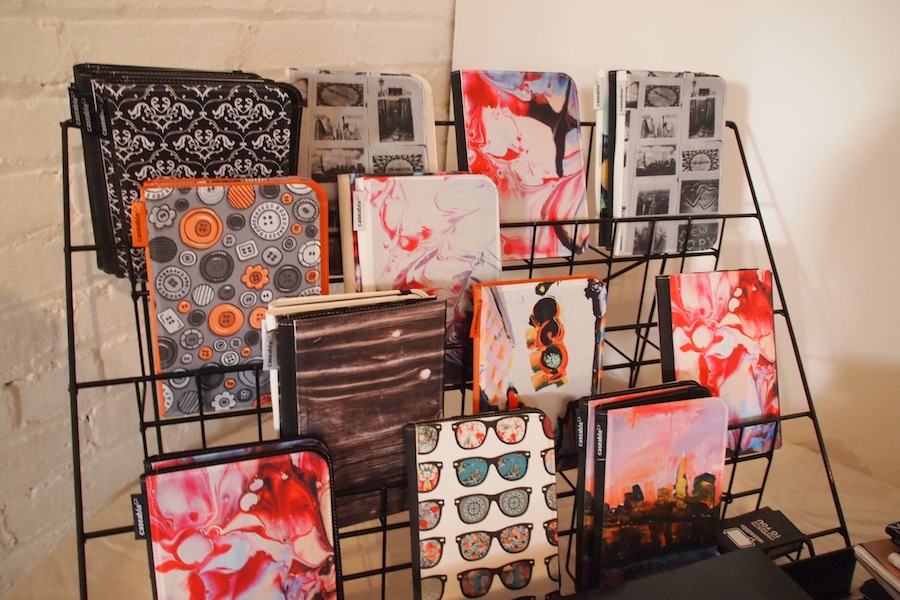
We stopped by the company’s Prospect Heights headquarters to get a glimpse of how its array of laptop, tablet, and smartphone cases go from a few clicks on its freshly redesigned website to hot off the screen printer. The tiny, loft-style office with exposed brick walls housed approximately 10 employees all of whom make the business happen. There is a second headquarter in Berlin as well, public relations manager Selena Yang tells me, and that’s where international orders would get re-routed.

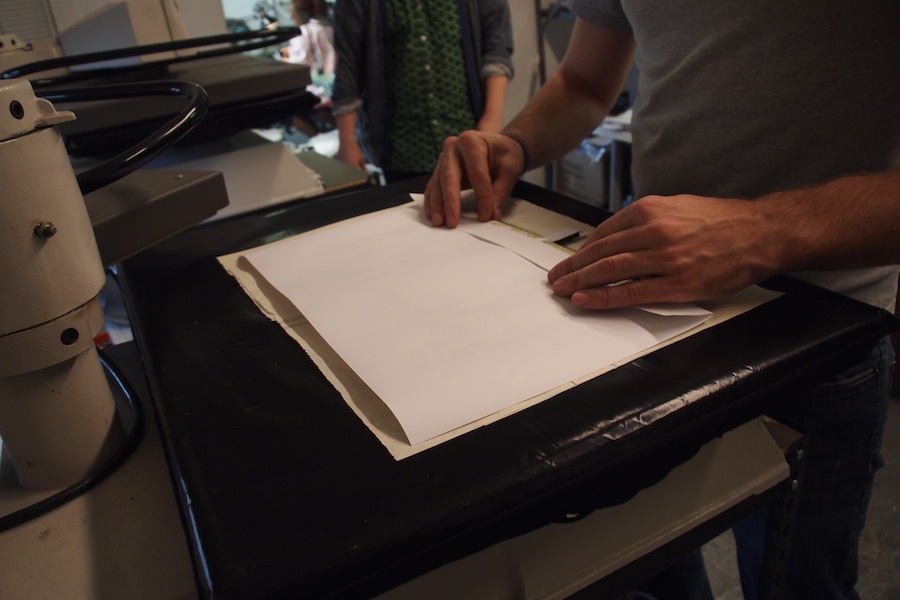
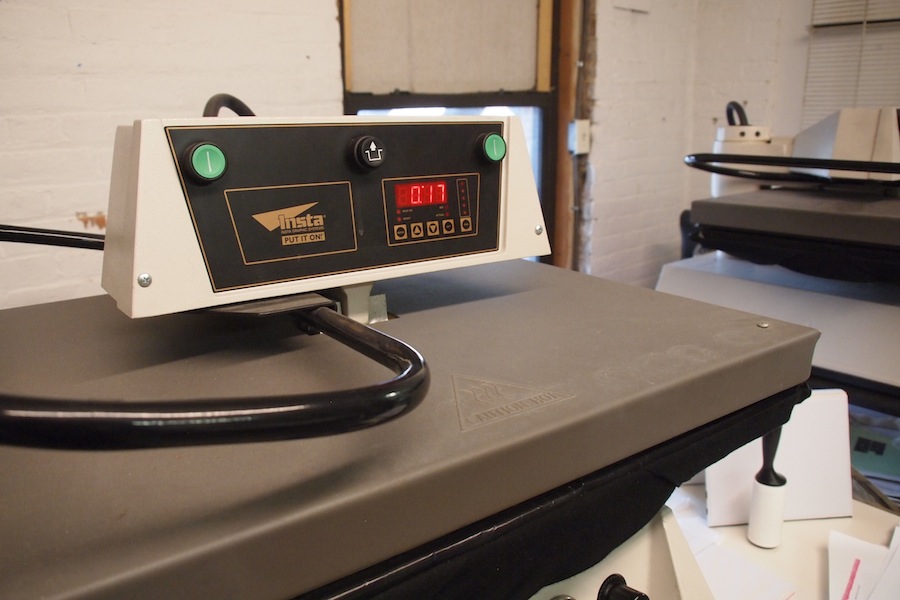
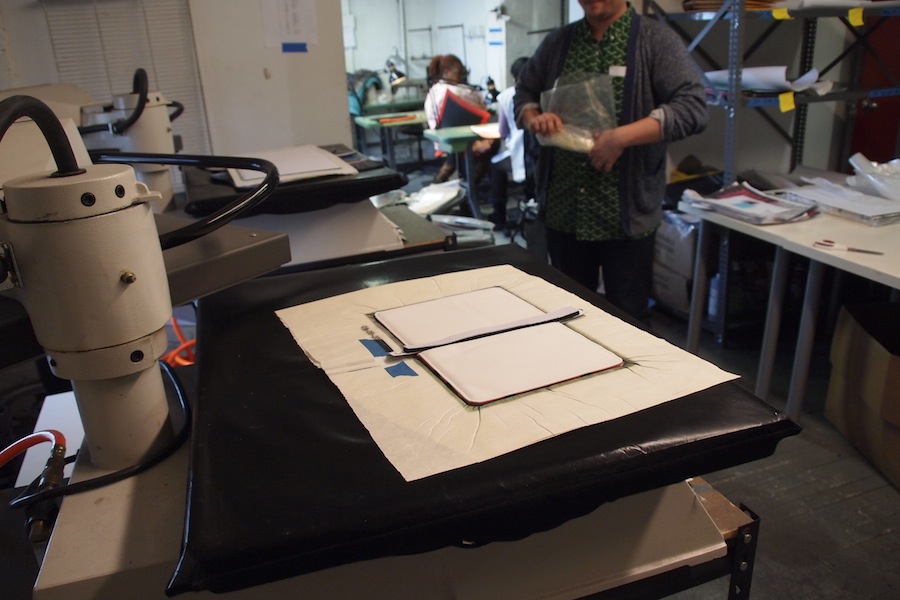
Everything is as hands-on as hands-on gets at Caseable. The orders come through one computer in the printing room, a production manager manually sends the photos to the printer and stacks them in a pile according to case color. Each print is carefully aligned atop a neoprene case before a large iron sandwiches the pieces together, using 400 degrees Fahrenheit of heat to transfer the ink onto the case. Twenty seconds later, a colorful iPad case is born. The process seems oddly simple, you wonder why more companies aren’t embracing handmade products at a larger scale.

“We fill a few hundred orders per day here at Caseable,” co-founder Marvin Amberg tells me, noting that orders have extensively increased thanks to the holidays. Although he cannot give exact numbers, he said the company grew about ten times since last year, and many times more since its initial launch in 2010. “Sometimes we work here until the sun comes up,” Amberg says, especially now that people want to gift a tech-infused accessory with their own personal stamp. A pile of laptop cases with imprints of “I love you Grandma!” and photo collages would prove his point.

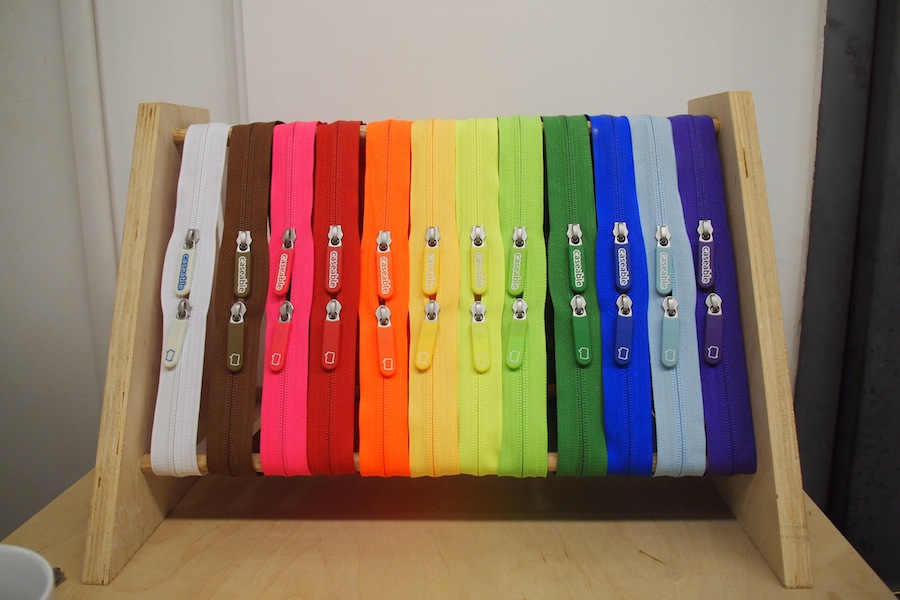
“We also have a lot of customer loyalty,” Yang adds. “People have already e-mailed us asking when the cases for an iPad mini and 7-inch Kindle Fire will be available.” The current company offering is rather extensive as it is, from MacBooks and 11 to 16-inch laptop cases to Kindle Paperwhite, Kobo Arc, Nexus 7, and even a BlackBerry Playbook. The company also collaborates with artists to feature unique designs for those who aren’t up to customizing their own.

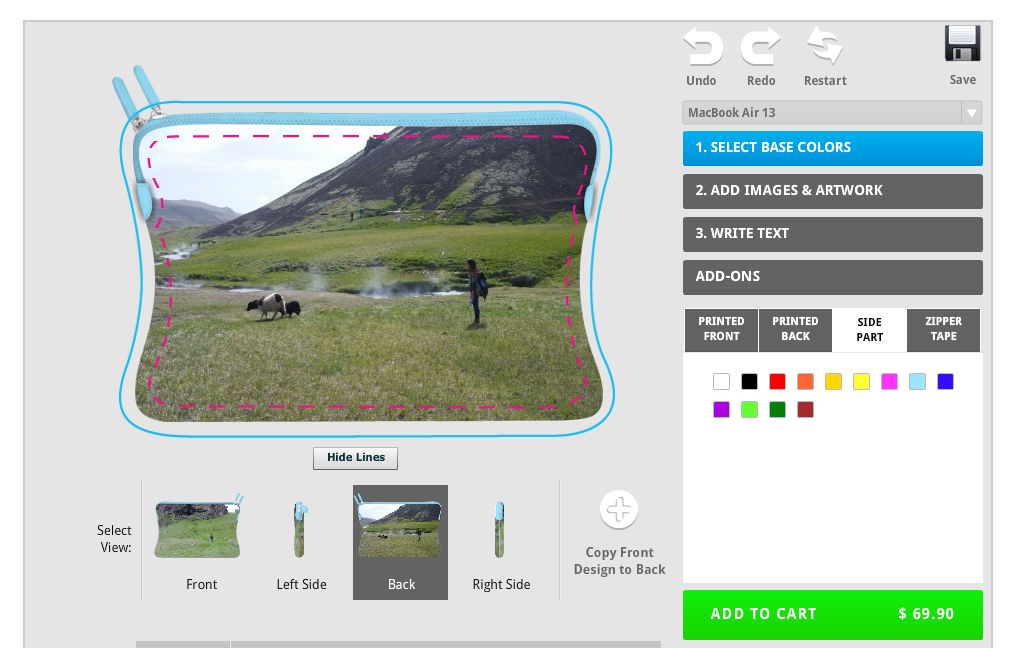
Each Caseable soft cases are made with recycled polyester fabric while hard phone cases are crafted with recycled water bottles. Going green is clearly a big deal here, and it’s one of the differentiating factor Caseable has over other customizable accessory companies. At the same time, quality and design aren’t quite compromised. As a parting gift, Yang printed me an iPad case using a photo of my recent trip to Iceland. Though the photo I provided her was not at its full resolution, the case still managed to sport a crisp, colorful shot that would make my mother proud to show off this Christmas. The inside also has a pocket flap to hold notes or business cards.

Although we only caught a short glimpse of the inner workings of this local factory, the visit felt more like stopping by someone’s humble abode than a business headquarter. You can tell everyone pours their passion into the product, crafting each piece with purpose. And heck, if they can do it, more power to those at home who call themselves an artist via a smartphone gallery of Instagrams. Now, both parties have their outlets – with a byproduct that’s rather beautiful and personal.


Source : digitaltrends[dot]com
9 ways the Web and connected computing are going to change in 2013

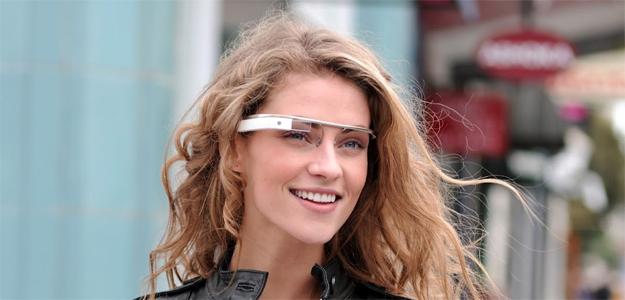
google glasses augmented reality vision brain memory

It's time to say goodbye to 2012 and look ahead to 2013 - and to start making predictions about how our connected world is going to change over the next year.

As the New Year approaches, predictions are being made across the tech world about the trends expected to hit the Web and the rest of connected computing in the coming year. Here are nine of the most game-changing growth areas that will continue to see advancement in 2013 and beyond. Get ready, the Internet is about to change.

1. Bio-integrated medical devices and personal electronic tattoos

A recent report released by the National Venture Capital Association (NVCA), PriceWaterhouseCoopers and Thomson Reuters, found that VC funding in biotech increased 64 percent in dollars to $1.2 billion in the third quarter of 2012 as compared to the previous quarter. As funding increases, so too have revolutionary advancements in the area that blends the bio-medical and technology fields. This trend will only continue with recent advancements in bio-integrated medical devices.

Bio-medical technologies that can either be stuck onto the skin similar to temporary tattoos or embedded into the body are emerging that are able to not only detect and monitor muscle, heart, and brain activity but also prevent medical conditions from seizures to heart arrhythmias by delivering electrical impulses.

“We’re trying to bridge that the gap from a silicon wafer type of electronic to a biological tissue-like electronics; to really blur the distinction between electronics and the body,” John Rogers, professor of Materials Science and Engineering at the University of Illinois Urbana-Champaign, explained to the National Science Foundation.

2. Cyborgs and tech-related sub-dermal implants

Another trend that has been emerging that meshes biology and technology is in the realm of body-enhancing electronic implants. This ranges from things like LEDs or magnets pierced under the skin to Radio Frequency Identification (RFID) implants. The functionality of these implants includes anything from location-based recognition and “sensory expansion” by being able to feel magnetic fields, to security and being able to secure wearable band-free gadgets.

Benjamin Popper, an editor at The Verge focused on the intersection of technology and culture, said, “This year has seen incredible progress in the advancement of cybernetics. A man with a bionic leg was able to climb the stairs at Chicago’s tallest building. He didn’t need a remote control, his brain was able to direct his mechanical limb as if it were his own flesh and bone. A robotic arm controlled by this woman’s thoughts has achieved new levels of fine motor control. 

“At the same time, bio-hackers are spreading Grinder culture into the mainstream, implanting magnets and RFID chips, giving those around them the first taste of the elective cyborg lifestyle. Google’s project glass went from its secretive X Labs to public display on the runway at New York Fashion week, where it was worn by Diane Von Furstenberg. As wearable computing becomes a reality next year, it will only accelerate the acceptance and demand for more complex and dramatic merging of humans and machines.”3.

3. Wearable smart electronics

A recent report but out by Gartner predicted that by 2016, wearable “smart” electronics would grow into a $10 billion dollar industry. The category of wearable electronics includes devices that can be inserted into athletic shoes for fitness tracking, like FitBit Ultra or Nike+, accessories like the previously mentioning Google Glass for hands-free communications or data access, gadgets like Sony SmartWatch or Pebble for instant access to anything from email to social media, and even medical-related gadgets. The increase in wearable electronics will change what it means to be “always connected.”

4. 3D Printing across sectors

3D printing is something that will have transformative effects in areas spanning medical, tech and retail. In the medial realm, 3D printers have already been used to create anything from prosthetic limbs to hearing aids. But 3D printing’s next feat will be in creating human organs; already, human tissue has been printed from these devices. Some reports even predict that pharmaceutical companies will be able to use 3D printers for drug development. In the tech space, researchers have recently created an inexpensive conductive plastic composite called carbomorph that will in the future allow consumers to 3D print personal electronics like smartphones, iPods and other devices. But 3D printers will also play a large role in the retail space, as the technology will allow consumers to print their own clothing and accessories. In an interview with USA Today, Steve Yankovich, head of eBay’s mobile business, said that 3D printers would eventually allow consumers to print the things they previously ordered online or bought in-store.

Across areas, 3D printing will also offer consumers a higher level of customization. Craig Elimeliah, the VP, Director of Creative Technology and Digital Solutions at RAPP, a multichannel marketing agency network, said, “3D printing gives us the opportunity to create experiences that lets both brands and their loyalists collaborate on product development, innovation as well and co-creation of physical branded objects. Brands should be releasing 3D printing schemas that are customized to enhance a product or a product experience…. As 3D printers become cheaper and more ubiquitous, we will witness a new era of the customer experience, an era where brands are engaging one-to-one with their consumers on a level so intimate that the products themselves will be a collaborative experience. Some examples could be a soap dispenser that matches your exact kitchen décor printed directly from your 3D printer and all you had to do was buy the refill. The examples are endless and the possibilities are exciting,” he said.

5. Rise of responsive Web

Currently, mobile devices make up more than 20 percent of Web traffic. As a result, companies are increasingly creating different versions of their sites optimized across channel—Website, tablet or smartphone. The vast majority of companies are still trying to play catch-up, creating separate versions of their Websites optimized for smartphones and tablets. But responsive web takes away the need for individually updating each version, and instead, optimizes all views just by updating to a single source. Websites like Hertz, The Boston Globe, and BarakObama.com are three examples of companies currently using responsive design, and WordPress even has some responsive native themes—including the Responsive Theme. We’ll see more and more companies utilizing this technology for efficient, multi-channel optimization.

“As the trend of mobile views continues to rise exponentially, Websites will need to quickly adapt to give the best viewing experience across all devices and screen sizes, and responsive Web design accomplishes that. With the responsive layout, you only have to make updates to the Website, and responsive Web will update based on trigger points for all other views and sizes,” explained David Broyles, web producer at Bobit Business Media.

6. Fluid, cross-channel personalized retail experience

E-commerce, as a percentage of total retail, is rising. Consumers are spending a larger share of their time and money online and as a result, retailers are trying to provide better and more personalized experiences optimized across channel—from tablets and smartphones to PCs and even in-store. Omni-channel, the connected yet unique multi-channel retail experience, is something consumers are beginning to expect and retailors are striving to deliver.

Currently, many retailors are simply extending their website experience across all channels, but increasingly savvy consumers are beginning to demand more—looking for experiences like buying online but picking up in store, buying in store but having it delivered or even using a smartphones as a replacement sales associate in store. In the near future, personal smartphones will be used to do anything from checking product availability in store to getting product information.

As brick and mortar stores evolve to stay relevant, they will increasingly turn to location-based technologies like RFID in order to offer customers more relevant and personalized shopping experiences. Gartner analyst Kevin Sterneckert recently told USA Today that in the near future, by the time a customer walks into a brick and mortar store, “the employees there will probably know what you want to buy, based on information on your trusty phone or tablet. Merchants will know your gender, age, race and income.”

“The omni-channel shopping paradigm is all about providing an immersive and consistent consumer experience across all channels. It’s about reinforcing your retail brand, educating customers about merchandise, and reducing purchase friction,” said Shahram Seyedin-Noor, the CEO and co-founder of GraphDive, which unlocks the power of social data to give vendors insights into their customer’s interests, preferences and demographics. “Not only will that increase in 2013, but it will bring into its fold much stronger elements of social personalization and integration. Retailers will have access to new platforms, such as GraphDive, that integrate and analyze “big data” from different sources—combining, for example, prior purchase behavior with Facebook data – to enable personalized user experiences across the Web, mobile, and offline worlds.”

7. Mobile payments will continue to grow

With the advent of and increasing access to technologies like Near Field Communication (NFC)— a wireless technology commonly used in one-tap payment solutions—payments will increasingly shift from cash and credit cards to mobile, on the consumer side.

But the mobile payment space will also have an affect for retailers, and will increasingly shift the point of sale (POS) from traditional cash registers to mobile devices—bringing the checkout process to the customer. Already, national chains like Nordstrom, Apple, Home Depot, and Sephora have begun replacing traditional cash registers for these mobile POS devices, making it easier and faster for consumers to check out.

8. Rise of the optimized mobile gadget

Tablets were first envisioned as mobile devices, but it’s rare to see people actually using their tablets in the truly mobile way that they use smartphones. As tablets evolve, they will shrink to the optimal size that features the largest possible screen that can be easily carried while on the go. In turn, smartphone screens will expand in size to the optimal size that still allows consumers to use them as mobile devices. Once that optimal device size is found, a hybrid tab-phone may emerge that can effectively be used for both browsing and talking.

9. Daily deals replaced with card-linked offers

The demise of the daily deal has long been predicted, but its successor hasn’t been much discussed. Card-linked offers, a daily deal-type platform connected to the customer through banks and merchant offers, bases personalized deals on the real-world spending behavior of consumers. Card-linked offers resolves many of the traditional pain points that both customers and retailers feel when using daily deal services like Groupon or LivingSocial.

On the consumer side, there’s no clipping, checking-in or registering for deals: personalized discounts based on past purchase history are instantly credited back to the bankcard used in the transaction. And deals are highly targeted based on each customer’s previous spending habits. On the merchant-side, there’s no training necessary, no change to POS and typically offers are based on pay-for-performance.


Source : digitaltrends[dot]com
Sci-fi tech that’s already becoming a reality

The future is now. With the year coming to an end, we look at some of the sci-fi tech that's already becoming science fact.

As with any year ending, we often take the time to think about how far we’ve come and where we’re headed. At least the world isn’t ending, right? What we tend to forget is the fact that we already live in the future. We may not have flying cars (yet), but we have phones that talk to us and robots that mop our floors. Our science fiction utopia can’t be that far off, can it? We found four pieces of tech we’re confident we’ll be seeing more of in the next year or two.

Mecha

Mecha are the, shall we say, more fantastic side of robots, the kind of walking weapons you’d see in shows like Gundam and Robotech, and more recently in films like Guillermo del Toro’s upcoming Pacific Rim (if you haven’t seen it, watch the trailer). Just answer this question: If you could be inside a giant robot monster, wouldn’t you wreak wanton havoc upon your enemies? Of course you would. Hence their everlasting appeal.

While you probably won’t see the kind of mecha that stand at skyscraper height anytime soon, 2012 was a red-letter year for the mech genre thanks to a certain Kuratas. The 13-foot tall, $1.35 million mech warrior went on sale last month. It features all the requisite equipment: rocket launcher shoulder pads and machine gun arms. It can be piloted from inside and, naturally, via smartphone. This is only the beginning.

Cloaking devices

Cloaking devices and invisibility cloaks have a storied history in both science fiction and fantasy. The human mind thrills at the thought of moving around completely undetected, and we have countless stories that employ the device in a myriad of ways, from ancient Norse legend all the way down to Harry Potter.

Unfortunately, actual scientific inquiry into whether or not that sort of thing is even possible is very much in its infancy. But this year, scientists were able to effect actual invisibility by manipulating the electromagnetic spectrum around a small object. You had to be observing the object from a single direction, sure, but it’s something.

While this isn’t the sort of thing you’ll likely see (or not see?) on the street anytime soon, the next few years could see increased military interest that can really push the research.

Self-driving cars

While robotics of the stripe that envisions automata walking among us is a little further off than we’d prefer, the idea of self-driving cars has gotten incredible traction in the last several years. Google has already demonstrated that they can create a driverless car that can perform better on the road than one piloted by a human being.

Right now, driverless cars are street legal in California, Nevada, and Florida. However, there are still questions to be answered. Namely, how might law change to reflect our understanding of “driver” when the car itself is doing all the work? And if an accident does happen, in what ways is he or she liable? In the coming years, those questions will have to be addressed in earnest.

3D-printed human tissue

Actually growing human tissue in a lab is maybe one of the scarier ideas in modern medicine, but it’s also one that desperately needs further study. Growing tissue to treat injuries, repair and replace organs, and maybe someday even grow limbs, could be the breakthrough that can eventually treat victims of disease and war.

But imagine printing that tissue in a machine as opposed to growing it in a petri dish. While Makerbot hasn’t signed up quite yet, scientists are currently working on ways to 3D-print human tissue in the hope of one day manufacturing human organs on demand.

Scientists are currently developing the tools needed to tailor printed tissue for such applications as burn wounds or creating new blood vessels from scratch. But as we move beyond fixing the human body to improving upon it, what kind of ethical concerns might be raised?

Invisibility photo via PopSci


Source : digitaltrends[dot]com

It's free
index