When we think about advances in technology and design, we might consider the Cupertino campus in California or perhaps a design house in Europe. That could be changing, as what you see here are a pair of products from a technology startup called VMK. They’re based out of Congo in Africa.
I don’t need to tell you that the African economy, in general, isn’t as strong as some other parts of the world. VMK is trying to change that, turning itself into the Congolese equivalent of a Samsung in South Korea or an Apple in the United States. VMK has revealed two of its initial designs for public scrutiny.
The first, shown above, is a smartphone called the VMK Elikia. Meaning “hope,” the Elikia is only running on Android 2.3.6 Gingerbread and a 600MHz processor, so it’s clearly targeting emerging markets (like Congo). Taking on a gentled curved back reminiscent of the Palm Pre, the Elikia features a 3.5-inch display, 512MB RAM, 123MB internal storage, Wi-Fi, Bluetooth and a 1300mAh battery. Expect this smartphone to sell for $170 outright.
The other product is the VMK Way-C tablet, which is similarly targeting emerging markets. Meaning “light of the stars” in the local Lingala language, the Way-C has a 1.2GHz processor, 512MB RAM and 4GB of internal storage. It is powered by Android 2.3.3 Gingerbread and has a 4200mAh battery. The Way-C is expected to retail for $300.
Neither device is groundbreaking in terms of design or performance, but it’s good to see a locally-designed family of products priced appropriately for the local African market.
A new post in the Google Play store by merchandising manager Tavares Ford outlines the top 12 Android apps for 2012 in the eyes of the search giant. Those of you that picked up a new Android handset or tablet this holiday will likely want to pay close attention as part of the fun with a new connected device is discovering the latest and greatest apps that everyone is using.
The best part about Google’s list is that all of the apps listed below are completely free! Here’s Google’s list from top to bottom with a brief description from Google Play:
Zappo’s - The best in mobile shopping with a great selection, free shipping and returns as well as an elegant new UI for phones and tablets.
Evernote - Stay on top of every element of your life, from anywhere. Take notes, capture photos and record memos with this amazing organizer.
Pinterest - Take full advantage of your Android device and set pins from anywhere using the built-in sharing system. Share and enjoy!
Grimm’s Snow White - A deceptively simple and well-executed storybook that serves as a perfect introduction to the world of Grimm's fairy tales.
Pocket - A full-featured offline reader that is constantly adding new capabilities like site subscriptions that let you save articles on paid sites.
Expedia Hotels & Flights - A beautiful and well-designed app that sets the bar for globally relevant travel tools with a rich and detailed tablet experience.
Ancestry - A unique and full-featured genealogy app that delivered a stunning design overhaul which also delivered new functionality.
Fancy - Fancy lets you share your personal style with style and brings a fresh perspective to the worlds of online shopping and fashion.
Mint.com Personal Finance - One of the most robust, feature-rich and intuitively designed tools available to help you master your personal finances.
Seriesguide Show Manager - Enjoy a great second-screen experience for TV that features an attractive, practical and well-planned design aesthetic.
Pixlr Express - A relatively new photography app that provides an amazing array of editing and photo-correction tools for both phones and tablets.
Ted - Enjoy talks and lectures from some of the world's most fascinating mavericks, gurus and legends.
Which apps do you use the most on your Android (or iOS / Windows) handset?
It seems that someone over at Huawei just could not wait any longer to show off the Ascend D2. The device pictured above, thanks to IT Home, was rumored to be making its first appearance at CES 2013. The specs are currently as follows:
5” 1920×1080 full HD screen
1.5GHz quad-core CPU (home made by Huawei)
2GB of RAM
13MP rear shooter
3,000mAh battery
Android 4.1 Jelly Bean
With the specs mentioned beforehand, the Huawei Ascend D2 would be a top of the line device if it is released soon. Furthermore, speculation puts this device alongside a $500 price tag. Compared to other devices with similar specs, half a grand is not bad.
As for software, the Ascend D2 will be utilizing on-screen buttons similar to that of the Galaxy Nexus and Nexus 4. Furthermore, judging by the leaked pictures, the operating system looks relatively stock despite the fact that the notification bar displays a percent next to the battery life meter.
CES 2013 is only a few weeks away. Be sure to bookmark Mobile Magazine and return during CES for more information on the Huawei Ascend D2 and many other upcoming announcements.
Are you excited for CES 2013? What are you looking forward to most of all? Let us know in the comments below.
The results of a new survey suggest more Americans than ever are reading e-books, reflecting the rapid rise in e-reader and tablet ownership.
The US is a nation of bookworms turning in ever increasing numbers to electronic devices to devour their novels, biographies and such like. Data published on Thursday by Pew Research showed that 23 percent of Americans aged 16 and over now read e-books, up from 16 percent in 2011.
Accordingly, the number of those who read printed books this year is on the decline, down to 67 percent from 72 percent a year earlier.
As of November – before the gift-giving season –Pew found that 33 percent of Americans own a tablet or e-reader, a significant jump from 18 percent a year earlier. Break those figures down and we see that a quarter of those in the US now own a tablet, up from 10 percent in 2011 and just 3 percent a year before that. Even e-reader ownership is on the rise, although with the growing popularity of the more versatile tablet – including smaller, more portable models like the 7-inch Kindle Fire HD, Nexus 7 and iPad Mini – a rapid decline in e-reader sales is expected.
Pew notes that libraries have been changing their ways to cope with the shift to electronic reading devices like Amazon’s Kindle Paperwhite or Apple’s iPad. Many are now offering e-books for loan, with 5 percent of users borrowing an e-book in 2012, up from 3 percent a year earlier. This relatively low figure can be linked in some part to awareness, with only 31 percent (24 percent in 2011) of library users realizing that libraries offer e-books.
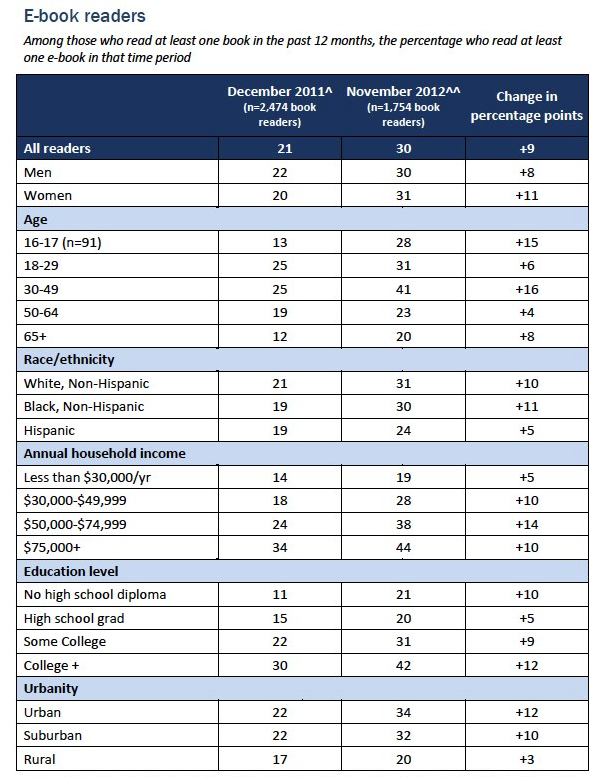
According to Pew’s research, those most likely to read e-books include people with college or graduate degrees, those living in households earning in excess of $75,000 a year, and those aged between 30 and 49 (see table below for full breakdown).
One thing is not in doubt – reading books continues to be a hugely popular pastime for Americans, with 75 percent of Americans aged 16 and over saying they’d read a book on any platform in the last 12 months, about the same as a year earlier.
Pew’s survey involved 2,252 Americans ages 16 and older and was conducted in October and November this year – before this year’s gift giving season.
Indeed, with so many consumers tearing the wrapping off tablets and e-readers this week, and with e-book purchases just a couple of taps away, it surely can’t be too long before the number of e-book readers catches up with the number of those who still prefer the feel of the printed page.
With 2012 drawing to a close, there are plenty of retrospective views around. So who are we to differ?
It's been a brilliant year in the technology space, so let's focus on what really got us excited: the stuff that changed the technology landscape, for better or for worse.
These are our key tech highlights from the last year.
It's been another bumper year for phones. Things are as tight as ever at the top, with key launches, patent wars and new tech taking centre stage in a way we rarely get to see. Be it Apple and Samsung's interminable courtroom battles, RIM's persistent system failures or mobile networks crashing, there's been a lot of negativity flying around.
Galaxy S3 takes on iPhone 5 and wins
The two key handset releases saw Samsung's Galaxy S3 rival the iPhone 5 in terms of hype and sales. It shows that perhaps the Apple hype-machine is starting to slow down.
Both launches came with a huge fanfare and impressive specs, but interestingly Apple's newest mobile hasn't gained the approving reception the Cupertino brand is used to.
It's impossible to expect something amazing to appear every year, but Apple also suffered badly from the fiasco surrounding its inaccurate Maps app and the subsequent embarrassing apology. This was definitely the biggest apology of the year – Apple event went as far as to suggest rival apps for users to download.
Now that Google has released its Maps for the iPhone, reports are suggesting that huge numbers of people are upgrading to iOS 6.
That mess aside, it's been an excellent year for phone software. Windows Phone 8 appeared to join Android Jelly Bean (in two variants) and iOS 6.
The iPhone 5 impressed, but it wasn't the best
Windows Phone moves up a gear
As we'll discuss in the computing space shortly, it's been a huge year for Microsoft. Windows Phone 8 is absolutely key to Microsoft's future stategy with phones and it brought a tranche of new features: resizable Live Tiles, NFC support, HD screens and multi-core processors, all designed to helps its devices sit proudly alongside the best on the market. And it's a decent OS – some may not like the stark design or limited apps store, but it's certainly a worthy addition to the landscape.
The UK finally got itself 4G mobile speeds, courtesy of EE. This means up to five times faster downloads on phones and tablets, although the cost is ridiculous - up to £56 a month for 8GB of data, £36 for 500MB.
The rollout is only in major cities at the moment, and while it's certainly faster, it's only useful where it's available. The spectrum auction for the other networks is taking place over the next couple of the months - expect rollout later in 2013.
Can Windows Phone 8 make a difference?
The year of seven inches
Moving onto tablets, this was the year that gave us three iPads, a Surface and two Nexuses plus new Amazon Kindles. We've long been of the opinion that a seven inch tablet is a great size of device as well, so hats off to Google and Amazon for forcing the price down.
Saying 2012 was the year of the tablet is a bit like saying 2012 was an Olympic year – the buying public sucked up iPads, Kindle Fires and Google Nexus 7 tablets like there was no tomorrow.
The Google Nexus 7 (made by Asus) has had a huge impact, as has the Amazon Kindle Fire HD. So Apple was forced into producing an iPad mini in October which failed to match the Google and Amazon efforts on price.
All three devices offer consumers a great choice: be it stunning design from the iPad mini, simple content access from Amazon's offering or raw, cheap power from the Nexus 7.
Apple forced home its advantage in the 10.1-inch space, replacing Spring's iPad 3 with the iPad 4 late in the year. Other players including Samsung and Asus also played to strengths here and Samsung partnered with Google for the Nexus 10.
The tablet of the year: Google Nexus 7
Can Surface make an impact?
And then there was Surface and the cut-down version of Windows 8 that it runs, Windows RT. This is Microsoft's reaction to the iPad, which is essentially Windows 8 on ARM. Surface has been a success in terms of profile but it doesn't seem to be translating it to sales, with everybody acknowledging £399 ($499) is too much for a stripped-back version of Windows 8.
Despite Microsoft reportedly upping production late in the year, it boasts lovely hardware but a poor app ecosystem at the moment. With Windows RT you see, desktop apps aren't supported, just apps from the Windows Store. As time goes on it seems more like Windows RT is a dead duck.
Onto full-blown Windows 8 for Intel and AMD devices then – this certainly is a seismic shift for Windows as Microsoft. We saw a lot more touch-based hardware than we were expecting to and more exciting Windows hardware continues to appear by the week.
Surface isn't selling in numbers, while Intel is surely rubbing its hands with glee as it continues to push laptops hard on price. The Intel-powered Surface Pro is due in January, but for a high end price – rather 'cheaper' is where laptops are heading. We've seen laptops like the Asus VivoBook S200 that combine portability, Windows 8 and a touchscreen for £450.
Our favourite Windows 8 laptop so far, the Asus VivoBook S200
Ultrabooks and Apples
2012 was certainly the year of the Ultrabook – these Intel-backed thin and light MacBook Air-equivalents made an impact over the last 12 months (even if sales seem a bit of a mystery), as did touchscreen tech thanks to Windows 8.
Google continues to try and launch Chromebooks (why? And why aren't they Android-based?) – some for as little as £199 – but, like Windows RT, they disappoint with their restricted approach to computing.
Apple trundles on, its Macs continue to succeed, but its sales remain dwarfed by the still-powerful PC. OS X received an iOS-style makeover with version 10.8 Mountain Lion, but it was mainly window-dressing. Still, the hardware impressed. One of its smartest moves was the Hybrid Drive, an innovation on OS X that makes an SSD and traditional hard drive appear as a single storage drive, with oft-used apps transferred to the SSD.
Apple continued to plead the post-PC message with iOS 6 for iPad and iPhone, but was quite happy to innovate in the Mac space, seemingly missing the point that Macs *are* PCs.
The retina display Macs impressed
Going beyond the PC
We didn't see a big leap in x86 CPU performance during 2012. We did see Intel launch the 22nm die-drink of its Intel Core processors (codenamed Ivy Bridge). AMD continued struggle and make cheap, decent chips, but it faces serious questions about its future next year despite the performance message of its new Trinity A-Series. AMD has said it will also make ARM chips in future.
Despite the ropey start to ARM-powered PCs, ARM-powered chips will press Intel hard over the coming years. "Is the era of x86 over? Not yet, but maybe soon if the weight of ARM-related processor developments is anything to go by," says our own Jeremy Laird. "One thing's for sure. The desktop CPU war is over."
But 2012 has been more about laying the foundations for a potentially epic 2013. Not epic in the traditional sense of major developments in CPU or graphics technology (though we'll see developments there, too).
But it could well be the year when we see the dissolution of the traditional concept of the PC. In 2012 it wasn't just Apple talking about taking things beyond the PC - even Microsoft is now showing it wants to reinvent PC tech. Every major PC manufacturer turn its attention to tablets; with some remarkably varied results, from convertible laptops to sliders to slates.
Are we seeing the beginning of the end of the x86 era?
OLED and 4K
But these are challenging times for tech companies, not only in computing, but in home entertainment, too. Many tech brands – Japanese ones in particular – are struggling just to keep their heads above the rising tides of financial ruin.
The endless conveyor belt of new products in home entertainment is truly impressive, especially when you consider that we're living in an age of such financial hardship.
The big stories this year revolved around OLED TVs, with Samsung and LG both launching amazing new 55-inch products, and Ultra HD, aka 4K. Ultra HD TVs have four times the number of pixels as regular full HD TVs, making them capable of producing fantastically sharp pictures and also enabling passive 3D tech to operate at a full HD resolution.
Ultra HD as an emerging theme is helped on by the fact that movie studios are now starting to shoot films at 4K resolutions, creating buzz and triggering visible marketing. Of the two televisual themes of 2012, it certainly seems as though OLED is the one that's fast falling out of favour.
Despite the tech producing the best, brightest pictures, yield rates in factories are so low that they're prohibitively expensive to buy and sell. It's been a long time now and no one has figured out the answer, so it could be that OLED goes the way of Canon and Toshiba's SED tech and dies a death.
One possible alternative is Sony's Crystal LED tech which it also launched at CES earlier this year, but that again, while super-impressive, is prohibitively expensive. And so while those two OLED monsters from Samsung and LG, announced in January, are still nowhere to be seen, 84-inch Ultra HD TVs from several brands are going on sale in time for Christmas. All you need to do is save up £25,000 and you'll be able to buy one.
The TV is fast becoming the central hub of entertainment and communication in the home, with Smart TV finally starting to come through as a feature people actually use. The reality is, though, that the high price of the best products continue to keep them out of most of our hands.
The Toshiba 55ZL2 was the first Ultra HD consumer TV announced. It uses the extra resolution to create glasses-free 3D
What happened to Blu-ray?
Since 2006, Blu-ray has had more marketing money thrown at it than any other home ents tech. But in 2012, Blu-ray seems to have hit its peak in terms of market saturation of devices and also in terms of innovation.
Instead, the interesting story in the world of content delivery has taken place deep in the digital ether. In 2012, Netflix became available outside the USA for the first time and launched a worldwide invasion, starting with the UK. A deal was first struck with Sony to get Netflix available on PS3, and smartphone apps,
Philips set-top boxes and other compatible products followed in their hundreds. Netflix chose the right time to offer its TV and Movie streaming services to a wider audience – at the same time, Amazon announced that streaming overtook DVD rentals in terms of usage within its Lovefilm service for the first time. Streaming is where it's at. And other services like Rdio and Spotify have come on leaps and bounds, too.
The streaming battle is hotting up
The year in gaming
2012 was also an important year for gaming hardware. We've seen new consoles launch shaped like PlayStation Vitas, Nintendo 3DS XLs, super-slim Sony PS3s, Nintendo Wii Us and in Canada Nintendo has also launched a super-cheap Nintendo Wii Mini.
Most of this new gear was received warmly. The PS Vita was not without its flaws but demonstrated its power and mobile gaming class.
The Nintendo 3DS XL was more or less the console that the disappointing 3DS should have been and thus was also embraced by the gaming world.
However, the super-slim PS3, made out of cheaper materials and containing a cheaper drive tray was a bit more disappointing. "It wasn't cheap enough", was the main complaint.
The Wii U also received a mixed reaction when it landed in November. Its hardware was said to be only just on a par with the 6-year old PS3 and 7-year old Xbox 360. Its games are just not as accessible as the original Wii games - an opinion mirrored far and wide. The Wii U's fortunes will surely make great reading moving into 2013.