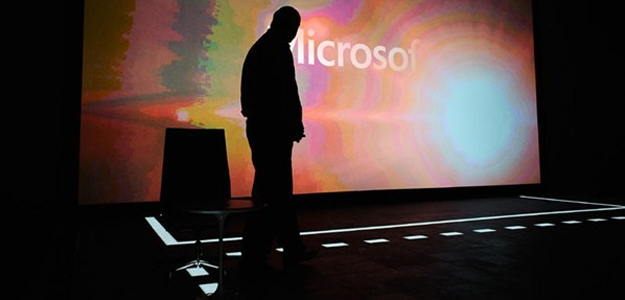
Windows 8 was a “Dear John” letter to manufacturers like Acer and Dell, and CES 2013 was the official breakup. Now what?
The biggest news of last week’s Consumer Electronics Show – that enduring altar at which the industry lays bare its sacrifices for the coming year – was not Ultra-HD televisions, censored satellite receivers, or even smart vacuums. Rather, it was the void left by one of the shows biggest stars. Microsoft, the anchor of the PC ecosystem, which since 1995 had given every keynote presentation at the event that had come to represent the ying to Macworld’s yang, was a no show.
With Windows 8 just hitting its stride, it may seem like a funny time for Microsoft to drop off the CES map. But Microsoft knows what its OEM partners won’t admit: PCs are already dead, Windows 8 was never meant for them anyway, and the future lies in Microsoft-built hardware. Here’s what the future holds for the company that made its fortunes in a mine that’s running out of gold.
The withering PC
You’ve heard it bellowed from the rooftops of tech punditry for at least the past few years. “Mobile is going to kill the PC,” they said. “The cloud is going to kill the PC.” Well, they were right. This holiday season marked the first one in half a decade that PC sales slumped, even at the most deliriously spend-happy time of the year. In fact, a decline of 6.4 percent in the fourth quarter, as reported by researchers at IDC, was even more than the pessimistic 4.4 percent drop initially anticipated. Dell was hit so hard in 2012 that it’s likely the company will be taken private in the coming year. And Acer, the Taiwanese giant that just a few years ago christened a new wave of low-cost, high-quality computers at chains like Best Buy, saw nearly 30 percent of its U.S. sales disappear.
Windows 8 was supposed to staunch the bleeding. It’s a touch-friendly upgrade that is faster and prettier than the wildly successful Windows 7 it replaces. It can run on tablets, and desktops, and even convertible laptops — the calculator watches of the PC world! Sales, however, have not been quite as robust as expected; even after a $1.5 billion advertising blitzkrieg, Microsoft CFO Tami Reller announced that 60 million Windows 8 licenses had been sold since its October launch. Though Reller said those figures followed a “similar sales trajectory” to that of Windows 7, she failed to mention that Microsoft had to substantially discount the OS to match it. Windows 8 sold for as low as $40, while Windows 7 started at $150 and only went up from there.
Why the slump? Rafi Kronzon, co-founder and managing partner at Cartwheel, an IT consulting and support company based in New York City, put it to me bluntly: “If you are not using a tablet, there is absolutely no reason to install Windows 8. On a traditional computer, it’s unintuitive, clunky, and obtuse.”
How could Microsoft risk alienating its bread-and-butter users like that? Because Microsoft sees the same numbers you and I do.
It doesn’t matter if you have the entire PC market cornered if the entire PC market keeps shrinking, and it should be no surprise to anyone that Microsoft is hedging huge on mobile as the future of all personal computing. Apple is in a unique position; it offers a premium product and has room to grow its OS X user base. As such, it can afford to stave off the PC market contraction for the time being. Microsoft on the other hand, with its market saturation and heavy reliance on hardware partners, has no such luxury.
Windows 8 was never meant for the masses
When I asked a Microsoft spokeswoman how businesses were faring in Windows 8 adoption — given the radical interface changes and historical staidness of corporate IT departments — she gave an unusual reply. “One of the great things about Windows 8 is the compatibility with Windows 7, so businesses can feel good about adopting it side-by-side with Windows 7.”
Um, what?
That statement coincides perfectly with CFO Tami Reller’s own leaked talking points to ReadWriteWeb from earlier this week, stating that “Windows 7 continues to be incredibly popular in the commercial space, and we recommend enterprise customers in the process of deploying Windows 7 continue with those deployments. There is great compatibility between Windows 7 and Windows 8, and this will make it easier to start adopting Windows 8 side-by-side with Windows 7.”
A year ago, MS quietly updated its support cycle for Windows 7 to a full 10 years, which will bring the OS into the next decade.
Microsoft is ostensibly keeping Windows 7 around indefinitely for desktop use. At the same time, it’s now building a steady user base of consumer mobile users (although how steady is really anyone’s guess) for what it sees as its great bet on the future. Further, it’s optimizing its lucrative productivity software for a mobile interface on its own OS first. Keep in mind that the Microsoft Office Suite is actually the most profitable card in Redmond’s deck, accounting for almost $24 billion in revenue in 2012. By comparison, Windows brought in just over $18 billion in 2012, down from $19 billion in 2011.
The future will not be licensed
Microsoft’s PR-approved rationale for leaving CES was that “our product news milestones generally don’t align with the show’s January timing.” But really, there’s a much larger shift underway. Call it the “Appleization” of consumer technology, call it whatever you want: Microsoft’s following it. Redmond plans to have 44 retail stores open by June, 2013, and they won’t be pushing Dell desktops. The hardware will say Microsoft.
“Microsoft couldn’t remain static,” Bennett Kobb, a long-time industry analyst and a senior member of the IEEE, told me. “The company would be wrong not to embrace the tablet paradigm now that tablets are finally practical. And they would further be foolish to ignore certain Apple lessons, such as, control the hardware and the OS.”
Yes, there is a good reason Microsoft CEO Steve Ballmer saved his one and only CES appearance for the otherwise tepid Qualcomm keynote: Partnerships with mobile-centric suppliers such as Qualcomm will ultimately be Microsoft’s salvation.
The Surface, which is by all accounts the best of the current Windows 8 bunch, is 100 percent Microsoft, and the opening salvo in what will be a torrent of Microsoft-designed hardware in the coming years. The company has already strayed from what was perhaps the most celebrated partnership in the history of the form — that with Intel — in favor of broader support for mobile ARM chips.
Microsoft’s official CES bow-out is the tech giant’s diplomatic uncoupling from the galaxy of OEM manufacturers it once groomed as if they were kin. It still needs OEMs while desktops are dominant and its hardware ducks aren’t quite in a row, but mark my words: Their days are numbered.
“People who are really serious about software should make their own hardware,” the renowned computer scientist Alan Kay said. The world isn’t quite ready for Microsoft to fully realize that vision; look hard enough at Windows 8 though, and you just might see the future.
Source : digitaltrends[dot]com


